


Wine
- Jul 23, 2020
- 41 min read
Updated: Jul 30, 2020
For the sake of being able to navigate a restaurant wine list with confidence.
Disclaimer: content has been summarised from winefolly.com & their book, Wine Folly: The Essential Guide to Wine by Madeline Puckette & Justin Hammack. Links to all articles & the book itself are listed at the end of this post.
Contents:
1. Wine Basics
• What is Wine
• Drinking Facts
• Wine Grapes vs Table Grapes
• Sulfite
• How Wine is Labelled
• Vintage
• Non-Vintage Wine
• Single-Varietal Wine
• Climate
• Wine Blend
2. Wine Characteristics
• Acidity
• Sweetness
• Alcohol
• Tannin
• Body
• Aroma Compounds
3. Wine Tasting
• Look
• Colour of Wine
• Smell
• Wine Faults
• Taste
• Taste Preferences are Generic
• Conclude
4. Handling Wine
• Wine Glasses
• Serving Wine
• Wine Temperature
• Wine Storage
5. Food & Wine Pairing
• Flavour Pairing Theory
• Cheese Pairing
• Meat Pairing
• Vegetable Pairing
• Herb / Spice Pairing
6. Sparkling Wine
• Cava
• Champagne
• Lambrusco
• Prosecco
7. Light-Bodied White Wine
• Albariño
• Grüner Veltliner
• Muscadet
• Pinot Gris
• Sauvignon Blanc
• Soave
• Vermentino
8. Full-Bodied White Wine
• Chardonnay
• Marsanne Blend
• Sémillon
• Viognier
9. Aromatic White Wine
• Chenin Blanc
• Gewürztraminer
• Muscat Blanc
• Riesling
• Torrontés
10. Rosé Wine
11. Light-Bodied Red Wine
• Gamay
• Pinot Noir
12. Medium-Bodied Red Wine
• Barbera
• Carbernet Franc
• Carignan
• Carménère
• Grenache
• Mencía
• Merlot
• Montepulciano
• Negroamaro
• Rhône / GSM Blend
• Sangiovese
• Valpolicella Blend
• Zinfandel
13. Full-Bodied Red Wine
• Aglianico
• Bordeaux Blend
• Cabernet Sauvignon
• Malbec
• Mourvèdre
• Nebbiolo
• Nero D'Avola
• Petit Verdot
• Petit Sirah
• Pinotage
• Syrah
• Tempranillo
• Touriga Nacional
14. Dessert Wine
• Madeira
• Marsala
• Port
• Sauternais
• Sherry
• Vin Santo
1. Wine Basics
What is Wine
Wine is an alcoholic beverage made with fermented juice of grapes. Any fruit is capable of being used for wine (apples, cranberries, plums), but if it just says “wine”, it’s made with grapes. Difference between wine & beer, is that brewing beer involves fermented grains.
Drinking Facts
A standard pour is 5 oz (150 ml) & contains ~ 150 calories & 0 to 2 grams of carbs. National Cancer Institute recommends that women have no more than 1 drink per day &
men have no more than 2.


Wine Grapes vs Table Grapes
Wine grapes are smaller, sweeter & have lots of seeds. Most wines originate from a single species of vine originating from Caucasus called Vitis vinifera. Thousands of different varieties within the Vitis vinifera species, most common being Cabernet Sauvignon.

Sulfite
Bottle of wine contains fermented juice of Vitis vinifera grapes & a small portion of sulfur dioxide (aka sulfites) as a preservative. Sulfites affect about 1% of the general population, & wineries are required to label their wines if they contain more than 10 ppm (parts per million). In US, wine has no more than 350 ppm sulfites & organic wine no more than 100 ppm. A can of Coke contains 350 ppm of sulfites, french fries 1,900 ppm, & dried fruits contain about 3,500 ppm.
How Wine is Labelled
Variety: E.g. a bottle of Riesling is made with Riesling grapes. Each country has different rules for how much of the variety should be included to be labeled as a varietal wine. (% of grapes required to be labeled as a single-varietal wine: 75% for US, Chile, New Zealand, South Africa, Australia, Greece. 80% for Argentina. 85% for Italy, France, Germany, Austria, Portugal, Spain,
Region: Common regions include France, Italy, Spain & Portugal
Name: Wines can be labeled with a made-up name. More often than not, a named wine is a blend of grape varieties that is unique to the producer. Named wines are occasionally found on single-varietal wines in order to differentiate between the wines that the producers make.

Vintage
Wine grapes take an entire season to ripen thus, wine is produced just once a year. Vint stands for “Winemaking” & Age for the year it was made. Vintage year listed on label is the year grapes were picked & made into wine. Harvest season in the northern hemisphere (Europe, US) is from August to September, & in the southern hemisphere (Argentina, Australia) it is from February to April.
Non-Vintage Wine
Wine without a vintage listed on the label is usually a blend of several vintages together; and in the case of Champagne, it will be labeled with “NV”.
Single-Varietal Wine
Made primarily with 1 type of grape. Common to see these wines labeled by the name of that grape variety. E.g. a bottle of Riesling is made with Riesling grapes. Each country has different rules for how much of the variety should be included to be labeled as a varietal wine. (% of grapes required to be labeled as a single-varietal wine: 75% for US, Chile, South Africa, Australia, Greece. 80% for Argentina. 85% for Italy, France, Germany, Austria, Portugal, Spain, New Zealand)
Climate
A temperate climate is where grapes grow best. Cooler climates make wines taste more tart.
Warmer climates make wines taste more ripe.
Wine Blend
Wine made with a blend of several grape varieties. Blending is a traditional winemaking method. Most wine blends are mixed after fermentation & aging. Field blend: grapes blended & fermented together. A famous example: Port wine.
2. Wine Characteristics
Acidity
Acidity contributes to wine’s tart & sour flavour. Most acids in wine come from grapes including tartaric, malic, & citric acid. Like many fruits, wine lies on the acidic side of the pH scale, ranging from about 2.5 (lemon) to 4.5 pH (greek yogurt). As grapes ripen, they become less acidic. Thus, wine from a cooler climate where it’s hard to ripen grapes will produce wines with higher acidity.
Sweetness
Derived from residual sugar (RS), leftover sweetness when not all the grape has fermented into alcohol. Sweetness ranges from bone-dry to very sweet. A dry wine can contain up to a half tea-spoon of sugar per glass. At the same sweetness level, wines with lower acidity taste sweeter than those of higher acidity.


Alcohol
Comes from yeast converting grape must (sugar) into ethanol. Alcohol may also be added to a wine, aka fortifying. Alcohol is the vehicle by which aromas travel from the surface of the wine to your nose. Alcohol adds viscosity & body to wine. Sense alcohol in the back of your throat as a burning sensation. Taste of alcohol is spicy, palate-coating & warms the back of your throat. Wine’s average range of alcohol is about 10% ABV (alcohol by volume) to 15% ABV. Exceptions: Moscato d’Asti as low as 5.5% ABV, & Port (fortified with neutral brandy) is up to 20% ABV. Alcohol level is often described as a temperature as it feels ‘hot’ in your throat. A “hot” wine has higher alcohol.

Tannin
A naturally occurring polyphenol found in plants. Unique to red wine, since white wines ferment without skins. Tannin is not necessarily a flavour but a textural astringent taste. Grape tannin comes from skins, seeds & stems. It is bitter & astringent but contains high levels of antioxidants. Oak tannin comes from oak barrels. To taste tannin, focus on the texture on your tongue. High tannin wine removes proteins from your tongue, causing a drying & puckering sensation. This sensation is often described as “grippy.” Put a wet, black tea bag on your tongue for a great example of how tannin tastes. High tannin wines act as palate cleansers to rich, fatty meats; cheeses & pasta dishes. Hence, they are often served with food.
Body
Not a scientific term, but a categorisation of style from lightest to boldest. Characteristics of sweetness, acidity, tannin & alcohol each affects how light / bold a wine will taste. Use terms like “light-bodied” or “full-bodied” to describe the style of wine you want to drink.

Aroma Compounds
Within the tiny minutia of wine (phenols, esters, higher alcohols, acids, etc.), you find the complexities of the wine’s flavours & aroma. Each grape variety exhibits aroma compounds at different levels. Hence some wines smell like berries & others smell like flowers. Ageing also contributes to wine’s aroma. Nearly all red wines are aged in oak, contributing an oak barrel’s flavour compounds (like vanillan) & acts as a conduit to expose the wine to oxygen. Oxidation & aging produce a range of unique flavours to wine, including nuttiness & dried fruit / flower flavours.
3. Wine Tasting
Look
Learn to identify clues about a wine from just inspecting colour, intensity, opacity & viscosity. For a tasting size, pour a 75 ml / 3 oz serving. View the wine with natural light over a white surface like a napkin / piece of paper.
Inspect: Angle the glass over a white backdrop & inspect the colour, intensity & hue at the rim of the glass.

Swirl: Swirl to see the viscosity. Viscous wines have higher alcohol and / or residual sugar.

Colour: Look at the hue & compare it to other examples of the same wine to see how it differs in terms of variety & production.

Intensity: Observe wine from the rim to the middle. See small differences in colour & clarity of a wine based on factors like variety, production & age.

Wine Tears: Wine “legs” / “tears” is a phenomenon called the Marangoni effect which is caused by fluid surface tension. Slow-moving “tears” indicate higher alcohol levels but do not signify quality.

Colour of Wine
Pale Platinum: A nearly clear white wine that refracts in the light is likely young & not aged in oak.

Medium Lemon: Several white wines have green hints in their colour like Grüner Veltliner
& Sauvignon Blanc.

Deep Gold: Oak aging will often give a white wine a deeper golden hue due to natural oxidation.

Pale Garnet: Pale red wines contain less of the red pigment anthocyanin. Pinot Noir, Gamay, Grenache & Zinfandel are naturally more pale in colour.

Medium Red: Wines that tint red typically have higher acidity than wines that tint blue-violet. Merlot, Sangiovese, Tempranillo & Nebbiolo tend to tint red.

Deep Purple: Opaque red wines contain more pigment. Aglianico, Malbec, Mourvèdre, Petite Sirah, Syrah & Touriga Nacional contain more anthocyanin.

Smell
Smell: Hold your glass under your nose & sniff once to “prime” your nose. Then swirl your wine once & smell again. This time, smell longer & slower but just as delicately. Switch between sniffing & thinking.
Aromas: Move your nose to different positions around the glass. Rich fruit aromas are generally found on the lower lip. Floral aromas & volatile esters can be smelled on the upper lip of the glass.
Swirl: Swirling wine releases aroma compounds into the air.
Overloaded?: Neutralise your nose by sniffing your forearm.
Perfume: Avoid wearing strong scents when actively tasting wine.
Primary Aromas: Primary aromas come from grapes. Each variety has a range of possible
aromas. E.g. white wine Sauvignon Blanc often smells like gooseberry / fresh-cut grass. Primary aromas depend on the climate where the wine was made & duration of aging.
Secondary Aromas: Secondary aromas come from reactions caused by wine yeast & bacteria during winemaking. E.g. aroma of butter is found in Chardonnay which comes from special bacteria.
Tertiary Aromas: Tertiary aromas come from aging & controlled interaction with oxygen. E.g. nutty flavours in vintage Champagne & Sherry are from years of aging.

Wine Faults
Some aromas encountered are faults. Learn them to differentiate good wine from bad wine.
"Corked": aka TCA Taint, 2,4,6-Trichloroanisole. Most corked wines smell strongly of wet cardboard, a wet dog / amusty cellar. But sometimes, a corked wine will just lack aromas & have very subtle musty aromas. You can return a faulty wine.

Reduction: aka Mercaptans, Sulfur Compounds. Reduction in wines smells like boiled garlic & cabbage. Occurs when a wine does not receive enough oxygen in bottle. To improve the smell, decant / stir your wine with a pure silver spoon.

Oxidised: aka “Maderised". Oxidised wines smell flat & are brown in colour, like an apple. Red wines will taste dry & bitter due to phenols (e.g. tannin) interacting with oxygen. Oxidised white wines typically have an apple cider–like odour.

UV Damage: aka “Light Strike”. Light strike occurs when wines sit under supermarket lighting for too long / are exposed to sun. Reduction occurs. Avoid light damage by storing wines in the dark & avoid “shelf-aged” bottles.

Heat Damage: aka “Cooked” / “Maderised”. Wine deteriorates quickly at 27.78°C & cooks at around 32°C. Cooked wines can smell pleasant like caramel & cooked fruits, but they will taste flat with no beginning, middle, or end. Heat damage also causes browning.

Spritz & Bubbles: (in a non-sparkling wine). Occasionally, wines will ferment again in the bottle. Identify this by presence of spritz in a wine that’s supposed to be still. These wines will typically be a little hazy due to yeast and protein particles.

Taste
Taste: Coat your mouth with a larger sip of wine followed by several smaller sips so that you can isolate & pick out flavours. Pick out at least 3 fruit flavours & 3 other flavours; one
at a time. Note that spitting is more common at professional tastings.
Identify: Identify where the basic wine traits hit your palate. Sweetness is toward the front. Acidity makes your mouth water. Tannin is textural & dries your mouth out like wet tea bag. Alcohol feels like heat in the back of your throat.

Profile: After tasting, create a mental profile of the wine. Organise the flavours & aromas by their category. E.g. for vanilla, it might be due to oak.

Advancing your palate: High-quality wines may have 2-3 distinct flavour profiles from start to finish.

Taste Preferences are Generic
Nonsensitive: 10 to 25% of people. Less than 15 taste buds. Can handle spicy food & love the richest, boldest flavours. Bitterness cannot be tasted at all. Primed for drinking the most intense wines in the world. Improve your sense of taste by spending more time smelling & identifying aromas.”
Average Taster: 50 to 75% of people. 15 to 30 taste buds. Bitterness like tannin can be tasted just fine, but it does not make you wince in pain. Capable of loving most wines. Improve palate by slowing down & paying attention to nuances.
Hypersensitive: "Supertaster”.10 to 25% of people. 30+ taste buds. Everything tastes
intense: salty, sweet, sour, oily & bitter. Not a fan of bitterness. Sensitivity makes you a more conscientious eater. Lean towards delicate, smooth wines. Asians, Africans & South
Americans have a higher proportion of supertasting genetics than Caucasians. Women are over 2 times more likely to be supertasters than men.
Conclude
Balance: Evaluate the wine. Do all the traits in the wine balance each other? A wine that is out of balance will have characteristics that overpower other flavours.
Improve Your Memory: Note a few key traits of the wine & commit them to memory. Traits / flavours specific to the grape variety / region / vintage / producer.
Personal Opinion: Take your time with wines that you enjoy. Identify what you prefer in wines. Use a simple 4-point rating system with a focus on drinkability. A “last meal” is so good you can die happy.
Washington State, California,
Blind Tasting: Practice blind tasting with bottles in a bag / wrapped in aluminum foil. Pour tastes of each wine & discuss characteristics to identify each wine with others. Easiest to start blind tasting with single-varietal wines. Then work up to blends. Set up your tasting in a well-lit room to improve your visual assessment.
Tasting Ideas: Regional Comparison: Try the same variety over several regions to see how geography influences flavour. Vintage Comparison: Find a series of vintages by a producer for a specific wine to learn how wine changes year to year. Quality Comparison: Put together a lineup of similar wines that vary in price to see how quality varies.
Writing Notes: Note the wine itself: producer, region, variety, vintage & any special designation. When you tasted it: Wine changes as it ages. Personal opinion: This is what really matters. What you saw: Will help identify winning themes. What you smelled: Be specific. What you tasted: Since we “taste” so much with our nose, add structural notes here & anything unique that you did not get in the smell. What you did: Because wine is an experience.
Try listing the most obvious flavours first to create a hierarchy of importance.
4. Handling Wine
Wine Glasses
Facts & Tips
- Hold stemmed glasses by the stem & close to the foot.
- Lead-free crystal glassware is dishwasher-safe.
- Leaded crystal contains 1% to 30% lead oxide. Fine crystal is 24% or more. Leaded crystal is not hazardous unless wine is stored in it for many days.
- When buying wine glasses, stick to 2 glass styles most suited to your drinking habits.
- Stems do not affect aroma or taste.”
- Stemmed glasses consist of the rim, bowl, stem & foot. Stemless glasses consist of rim, bowl & base.

Crystal vs. Glass
Crystal stemware refracts light due to its mineral content which also strengthens the crystal, allowing it to be spun very thin. Traditionally, crystal glassware is leaded, but today there are lead-free options made with magnesium & zinc. Leaded crystal glasses are porous & should be hand washed with fragrance-free soap.
Standard glass is technically more fragile than crystal but it’s spun thicker to make it more durable. Regular glass is dishwasher-safe.
How Shape Affects Taste
The bowl of a glass affects aroma intensity while the rim affects how much wine hits your palate.
Large round bowl: collects more aromas from larger exposed wine surface. Ideal for delicate, aromatic wines.

Narrow bowl: collects less aromas & has less wine surface exposed to air. Ideal for spicy, bold wines.

Choosing Glassware (all 150ml unless stated)
Stemless: Casual tasting encounters
Oversized Red: Medium-to full-bodied high tannin red wines
Aroma Collector: Light reds, full-bodied whites & rosé wines
Red: Spicy reds, vintage sparkling & rosé wines
Sparkling: Better for preserving carbonation in sparkling wines
White: Whites, rosés & sparkling wines
Dessert Wine (3oz / 90ml): Fortified & dessert wines

Serving Wine
Opening Still Wine
1. Remove the Foil: Does not matter if you cut the foil above / below the lip, although tradition is to cut below.

2. The Worm: Insert the worm off-center & rotate the screw until the worm is about 95% of
the way in. Slowly pull the cork out to reduce breakage.

3. Standard Pour: Standard serving size for wine is about 5 to 6 oz / 150 to 180 ml. Dry wines
average 130 to 175 calories per glass depending on alcohol level.

Opening Sparkling Wine
1. The Cage: Remove foil & untwist tab 6 times. Keep your thumb on cage & cork; they will come off together.

2. Twist: With 1 hand firmly holding cork & cage, use your other hand to rotate the bottom of the bottle.

3. Release: When cork pushes, resist it & slowly release it. Keep bottle at an angle for a second or two after you remove the cork.

Aerating Wine to Improve Flavour
Decanting introduces oxygen to wine. This oxidises stinky aroma compounds into less detectable smells & reduces concentration of certain acids & tannins, making wine taste smoother. Get a decanter that is easy to fill, pour & rinse. A wine aerator is technically more efficient although not as stately. Smell sulfur? It just means your wine is “reductive”. Decanting will improve the smell & so will stirring the wine with a silver spoon.

Pour: For increased air-to-wine contact, pour wine so it distributes on the sides of the glass as it fills.

Wait: The bolder & more concentrated the wine, the longer you should wait. 15 to 30 minutes is a good starting point.
What to Decant: All red wines can be aerated. An aerated wine won’t store open for long, hence, decant only what you plan to drink.
Wine Temperature
Serving Temperature

Too Cold: Might be served too cold if it lacks aroma & tastes sour. This is a common problem for white wines stored in the fridge. Cup the bowl with your hands to warm your glass.
Too Hot: Might be too hot if the aroma burns your nose & smells medicinal. This is
common with higher alcohol red wines that are stored in ambient home temperatures. Cool the bottle for 15 minutes
Wine Storage
Storing Open Wine
Wines quickly deteriorate when exposed to oxygen / ambient home temperatures. Store
open wines in a chiller at 10 to 13°C. If you do not have a wine chiller, store open wines in a fridge & let them warm up for about an hour before serving.

Re-corking a wine stops outside oxygen from getting in, but it does not remove the oxygen inside. A wine preserver like a vacuum pump / argon gas preserver keeps your wine fresh for longer.

Aging Wine
Ideal storage temperature is 10 to 13°C & 75% humidity. Wine ages 4 times faster
stored in a pantry / closet. Variable temperature environments causes wine to develop faults. If you plan to age wine for more than a year, look into purchasing a wine fridge /
related cellaring solution.

There are 2 types of wine fridges: thermoelectric & condenser. Thermoelectric chillers fluctuate with temperature but are more quiet. Condenser-type chillers are louder & require maintenance intervals but are more temperature accurate.

5. Food & Wine Pairing
Flavour Pairing Theory
Flavour pairing is the practice of finding what foods go well together by paying attention to taste, aroma, texture, colour, temperature & intensity.
Congruent vs. Complementary
Flavours match together in a congruent / complementary manner. Congruent pairings have many shared compounds that combine together & intensify. Complementary pairings oppose & counteract each other to create balance.
Food & Wine Pairing Tips
Acidic Food: High acidity foods make lower acidity wines taste flat. Match high acidity foods with high acidity wines.
Rich Food: A high tannin red wine acts as a palate cleanser to rich, fatty proteins.
Spicy Food: A cold sweet wine with low alcohol will counteract the burn of spiciness.
Pungent Food: Pungent flavours like Gorgonzola matches with wines that have higher acidity & sweetness.
Bitter Food: They magnify the bitterness of tannin. Try pairing bitter foods with low or no tannin wines with salinity & sweetness.
Sweet Food: Often makes dry wines taste bitter. Try matching sweet foods with a sweet wine
Wine Pairing Considerations
These 6 tastes are just a portion of what humans sense. Others include fizziness, umami (meaty), numbness, electricity, soapiness, calcium & coolness (menthol).
Create balanced pairings by matching the intensity of the wine with the intensity of the food.

Cheese Pairing

Meat Pairing

Vegetable Pairing

Herb / Spice Pairing

6. Styles of Wine
(i) Sparkling Wine
Sparkling wine is carbonated by yeast fermenting in an airtight container. 2 most common sparkling winemaking methods are “traditional method” & “tank method.” Sparkling wine is produced throughout the world & often follows the same winemaking methods & grape varieties found in Champagne.
Tank 'Charmat' Method: E.g. Prosecco & Lambrusco. Medium-sized spritzy bubbles & 2 to 4 atmospheres of pressure.
Traditional Method: E.g. Champagne, Cava, Crémant, US sparkling wine, Metodo Classico (Italy), Cap Classique (South Africa). Small persistent bubbles & 6 to 7 atmospheres of pressure.
1. Cava
Traditional method is used. Originates from Penedès, Spain & elsewhere in Spain (~79,000 acres). Sparkling glass at ice cold temperature is recommended. Drink-by-date is up to 2 years. Cheap at ~USD $5 to $10.
3 primary grapes of Cava: Macabeo (adds floral, apricot & berry flavours), Xarello (adds acidity) & Parellada (adds quince, apple & citrus flavours).
3 quality levels indicated by sticker / band on bottle: Cava (Standard) 9 months min. aging, Reserva 15 months min. aging & Gran Reserva 30 months min. aging with vintage dating.
Versatile with food due to palate-cleansing effect. Try with chilli, huevos, nachos & tacos.
Profile

Dominant Flavours

Possible Flavours

How Climate Affects Taste of Vintage
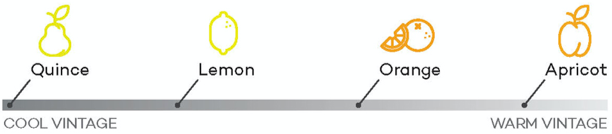
2. Champagne
Traditional method is used. Originates from Champagne, France (83,000 acres). Flute / White glass at ice cold temperature is recommended. Drink-by-date is 10 years. Expensive at ~USD +$30.
3 grapes of Champagne for white & rosé wines: Pinot Noir (adds orange & red fruit flavours), Pinot Meunier (adds richness & yellow apple flavours) & Chardonnay (adds citrus & marzipan flavours).
5 common styles: Non-vintage (consistent house-style wines), Blanc de Blancs (100% Chardonnay wines), Blanc de Noirs (P. Noir & P. Meunier wines), Rosé (Rosé wines with red fruit flavours) & Vintage & Special Cuvée (aged Champagne wines)
NV wines age for 15 months min. while vintage Champagne ages for 36 months min. Special cuvée Champagne aged for ~ 6 to 7 years develops nutty tertiary aromas. More than 90% of Champagne is made in the brut style; with less than a half gram of sugar per glass.
Profile

Dominant Flavours

Possible Flavours

How Climate Affects Taste of Vintage

3. Lambrusco
Pronounced "lam-broos-co". Tank 'Charmat' method is used. Originates from Emilia-Romagnia & Lombardy, Italy (33,000 acres). White / Red glass at cold temperature is recommended. Drink-by-date is up to 2 years. Moderate costing at ~USD $15 to 20.
3 sweetness levels: Dry Lambrusco ("Secco" indicates a dry style), Off-Dry Lambrusco ("Semisecco" indicates an off-dry style) & Sweet Lambrusco ("Dolce" & "Amabile" indicates a sweet style).
5 common styles: Lambrusco Di Sorbara (red fruit & flower; lighter style), Lambrusco Rosato (Rosé) (red fruit & flower; lighter style), Lambrusco Grasparossa (black fruit & plotting soil; bold style), Lambrusco Salamino Di Santa Croce (black fruit & plotting soil; bold style), Lambrusco Reggiano (black fruit & plotting soil; bold style)
2 most planted of over 13 Lambrusco varieties are Lambrusco Salamino & Lambrusco Grasparossa.
Profile

Dominant Flavours

Possible Flavours

How Climate Affects Taste of Vintage

4. Prosecco
Pronounced "pro-seh-co". Tank 'Charmat' method is used. Originates from Veneto & Fruili, Italy (15,000 acres). White glass at ice-cold temperature is recommended. Drink-by-date is up to 2 years. Between cheap & moderate costing at ~USD $10 to 15.
3 sweetness levels: Brut (0 to 12g/l RS; up to 0.5g of sugar per glass), Extra Dry (12 to 17g/l RS; just over 0.5g of sugar per glass), Dry (17 to 32g/l RS; up to 1g of sugar per glass)
3 main quality levels: Prosecco (most common type), Prosecco Superiore (higher quality due to production standards), Conegliano Valdobbiadene & Colli Asolani (“millesimato”; single vintage Prosecco wines)
Has about 3 atmospheres of pressure. Try pairing with cured meats & fruit-driven appetisers like prosciutto-wrapped melon. Also pairs well with
middleweight Asian dishes like pad thai & Vietnamese vermicelli noodles.
Profile

Dominant Flavours

Possible Flavours

How Climate Affects Taste of Vintage

(ii) Light-Bodied White Wine
Known for dry & refreshingly tart flavour. Most are meant to be enjoyed young when they have max. acidity & bold fruit.
Method:

1. Albariño
Pronounced "alba-reen-yo". Aka Alvarinho. Originates from Northern Portugal & is now grown in Spain, Portugal, USA & elsewhere (19,000 acres). White glass at ice cold temperature is recommended. Drink-by-date is up to 2 years. Moderate costing at USD $15 to $20.
2 regions: Rias Baixas, Spain (90% of vineyards are dedicated to Albariño), Minho, Portugal (Alvarinho is one of the grapes in Vinho Verde, which is a crisp, aromatic white wine often with some spritz)
Aromas: Melon & grapefruit aromas come from a group of aroma compounds called thiols which are commonly found in light white wines from cooler-climate growing regions, like Sauvignon Blanc from New Zealand, from France & Pinot Grigio from northern Italy.
Albariño is particularly well suited to Thai, Moroccan & Indian cuisine.
Profile

Dominant Flavours

Possible Flavours

How Climate Affects Taste

2. Grüner Veltliner
Pronounced "Grew-ner Felt-lee-neer". Originates from Austria & is now grown in Austria, Slovakia, Czech Republic, Hungary & elsewhere (50,000 acres). White glass at ice cold temperature is recommended. Drink-by-date is up to 2 years. Moderate costing at USD $15 to $20.
3 main quality levels: Landwein (typically low alcohol wines made in bulk), Qualitätswein (Austria's mark of quality Grüner Veltliner), Dac (subregional Qualitätswein with a light style; Classic & rich style; Reserve)
2 common styles: Light & Zesty: Most common & affordable style, known for
tingling acidity & simple melon/lime flavours. DAC wines are labeled “Classic.” Rich, Fruity & Peppery: a richer style often labeled “Reserve (DAC)” / “Smaragd (from Wachau)” in Austria. Dry & taste of honey, apple, smoke, mango & white pepper.
Grüner Veltliner pairs particularly well with aromatic vegetables, tofu & Japanese cuisine. (ginger, yuzu, wasabi, green onion)
Profile

Dominant Flavours

Possible Flavours

How Climate Affects Taste of Vintage

3. Muscadet
Pronounced "muss-kuh-day". Aka Melon de Bourgogne. Originates from Loire, France (31,000 acres). White glass at ice cold temperature is recommended. Drink-by-date is up to 2 years. Between cheap & moderate costing at USD $10 to $15.
2 regions making up 90% of Muscadet wine: Muscadet Sèvre-et-Maine (This appellation produces over 70% of Muscadet wine), Muscadet (This appellation has lower quality standards than Muscadet Sèvre-et-Maine)
Melon de Bourgogne or just Melon is the grape of the Muscadet region in France. It is common to see “sur lie” on a bottle of Muscadet which means “on the lees”; a term used to describe a process where wine is aged on the dead yeast particles for a period of time. Lees aging adds an oily mouthfeel & yeasty bread-like flavours to wine. It is common to
find it in white wines like Muscadet, Viognier, Marsanne & many sparkling wines. Muscadet goes well with shellfish & fish and chips. With high acidity, Muscadet pairs with pickled ingredients & vinegar-based sauces. (shellfish, lemon, fried food)
Profile

Dominant Flavours

Possible Flavours

How Climate Affects Taste of Vintage

4. Pinot Gris
Pronounced "pee-no gree". Aka Pinot Grigio, Grauburgunder. Originates from France & Italy & is now grown in Italy, USA, Germany, Australia, France, Moldova, Hungary & elsewhere (108,000 acres). White glass at ice-cold temperature is recommended. Drink-by-date is up to 5 years. Between cheap & moderate costing at USD $10 to $15.
4 common types of Pinot: Pinot Gris (gray-purple grape used for white & rosé wine), Pinot Blanc (white wine grape), Pinot Noir (black grape for red & rosé wine), Pinot Meunier (black grape used mainly in Champagne)
3 common styles: Minerally & Dry (mostly known as Pinot Grigio, from northern Italy, with citrus notes & salinity), Fruity & Dry (style is found in USA, Australia & other warmer climate regions), Fruity & Sweet (style is found mostly in Alsace, France & offers flavours of lemon, peach & honey)
Ramato (a unique style in Friuli-Venezia Giulia region, Italy) juice macerates on the grape skins for ~ 2 to 3 days to make a pale-copper-hued rosé. Try pairing Pinot Gris with light
flaky fish dishes, crab & softer cow’s milk cheeses like a triple-cream cheese.
Profile

Dominant Flavours

Possible Flavours

How Climate Affects Taste

5. Sauvignon Blanc
Pronounced "saw-veen-yawn blonk". Aka Fumé Blanc. Originates from France & is now grown in France, New Zealand, Chile, South Africa, Moldova, USA, Australia, Romania, Spain, Italy, Ukraine, Argentina & elsewhere (272,000 acres). White glass at ice-cold temperature is recommended. Drink-by-date is up to 2 years. Cheap costing at USD $5 to $10.
3 examples of regional differences for Sauvignon Blanc: North Coast, CA, USA (white peach dominant fruit flavour), Loire Valley, France (lime dominant fruit flavour), Marlborough, New Zealand (passion fruit dominant fruit flavour)
Barrel-Ageing is a style made famous by Robert Mondavi in 1970s when he renamed his
barrel-aged Sauvignon Blanc to Fumé Blanc ( pronounced“foom-aye blonk”). Barrel-aged Sauvignon Blanc tastes creamy while still exhibiting the variety’s trademark “green” notes. (Cream, pear, tarragon)
Sauvignon Blanc has similar flavours with Austrian Grüner Veltliner, Spanish Verdejo, French Gros Manseng and Colombard & Italian Vermentino.
Sauvignon Blanc is a parent of Cabernet Sauvignon. The cross happened naturally between Cabernet Franc & Sauvignon Blanc during the 17th century in western France.
Profile

Dominant Flavours

Possible Flavours

How Climate Affects Taste

6. Soave
Pronounced "swa-vay". Aka Garganega. Originates from Veneto, Italy (20,000 acres). White glass at ice-cold temperature is recommended. Drink-by-date is up to 2 years. Between cheap & moderate costing at USD $10 to $15.
3 wine growing zones: Soave & Soave Superiore (A larger production zone. Soave Superiore has longer aging requirements), Soave Classico (original classic growing zone
located in the hills), Soave Colli Scaligeri (Wines from hillside vineyards outside the classic zone)
2 common styles: Light & Zesty (Young Soave wines taste of honeydew melon, saline,
marmalade & white peach, with subtle notes of green almond), Rich, Honeyed & Floral (Older vintage Soave wines taste of candied fennel, saffron, honey, baked apple,
& preserved lemon. Look for Soave aged for 4 or more years)
Soave pairs very well with shellfish, chicken, tofu & hard-to-pair foods like split peas, lentils & asparagus. Garganega is the same grape as Grecanico in Sicily. Grecanico wines tend to be bolder & more fruity while Soave wines tend to be more lean & crisp.
Profile

Dominant Flavours

Possible Flavours

How Climate Affects Taste of Vintage

7. Vermentino
Pronounced "vur-men-tino". Aka Rolle, Favorita, Pigato. Originates from Italy & is now grown in Southern France & Corsica, Central Italy & Sardinia & elsewhere (22,000 acres). White glass at ice-cold temperature is recommended. Drink-by-date is up to 2 years. Between cheap & moderate costing at USD $10 to $15.
2 growing regions: Sardinia, Italy (Vermentino is the 2nd most planted grape in Sardinia. Fine Vermentino wines come from northern Sardinia), Tuscany, Italy (Vermentino grows primarily along the coast of Tuscany & extends up into Liguria)
Often noted for having a bitter note on the finish that tastes similar to grapefruit pith, which is referred to as phenolic bitterness; a common feature in several Italian white wines, like Verdicchio, Grechetto di Orvieto & Vernaccia di San Gimignano.
Due to its complexity, Vermentino stands up well to richer foods like seafood gumbo, fried calamari & tomato-based sauces.
In Southern France, Vermentino is called Rolle & is a key blending grape in Provence Rosé.
Profile

Dominant Flavours

Possible Flavours

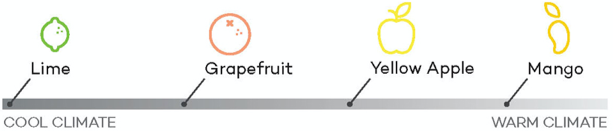
How Climate Affects Taste
(iii) Full-Bodied White Wine
Known for rich, bold flavours. Often aged on their lees / in oak barrels to add unctuous
flavours of cream, vanilla & butter.
Method:

1. Chardonnay
Pronounced "shar-dun-nay". Originates from France & is now grown in France, USA, Australia, Italy, Chile, South Africa, Spain, Argentina, Moldova, New Zealand & elsewhere (491,000 acres). White glass at cold temperature is recommended. Drink-by-date is up to 5 years. Moderate costing at USD $15 to $20.
Regional differences: Pineapple & Yellow Apple (California, South Australia, Spain, South Africa, Argentina, South Italy), Quince & Starfruit (Burgundy France, Northern Italy, Coastal Chile, New Zealand, Western Australia, Oregon)
3 Common Styles: Oaked Rich & Creamy (found in California, Chile, Australia, Argentina, Spain & Côte de Beaune), Unoaked Light & Zesty (Mâconnais, Chablis & western Australia), Sparkling (“Blanc de Blancs” labeled sparkling wines are made with Chardonnay)
Try serving a rich creamy Chardonnay warmer at 13°C at it will release more aromas into the bowl of the glass & make the wine bolder. Chardonnay is the world’s most planted white grape. Bourgogne Blanc is normally 100% Chardonnay.
Profile

Dominant Flavours

Possible Flavours

How Climate Affects Taste

2. Marsanne Blend
Pronounced "mar-sohn". Aka Châteauneuf-du-Pape Blanc, Côtes du Rhône Blanc. Originates from Rhône Valley, France & is now grown in Marsanne, Roussanne, Viognier, Grenache Blanc, Clairette, Bourboulenc, Piquepoul & elsewhere (~120,000 acres). White glass at cold temperature is recommended. Drink-by-date is up to 5 years. Moderate costing at USD $15 to $20.
Regional facts: France (Generally, French white Rhône blends are light-bodied as they are a blend of many varieties like Marsanne, Roussanne, Grenache Blanc, Clairette, Bourboulenc & Viognier), USA (Marsanne & other white Rhône varieties became popular in US after Tablas Creek winery in Paso Robles imported cuttings from Château de Beaucastel in Châteauneuf-du-Pape)
2 Examples of flavours from different dominant grapes: Peach & Flowers (Viognier), Pear & Beeswax (Marsanne & Roussanne)
If you prefer a richer style, look for white Rhône blends with higher proportions of Viognier & Marsanne grapes in the blend.
Profile

Dominant Flavours

Possible Flavours

How Climate Affects Taste

3. Sémillon
Pronounced "sem-ee-yawn". Originates from France & is now grown in France, Australia, Chile, South Africa, Argentina, USA, Turkey & elsewhere (57,000 acres). White glass at cold temperature is recommended. Drink-by-date is up to 10 years. Between moderate & expensive costing at USD $20 to $30.
Regional differences: Lime, Saline & Chamomile (Bordeaux, Hunter Valley in Australia, Washington), Papaya, Apple & Lemon Curd (South Australia, California)
3 Common Styles: White Bordeaux Blend (Zesty white of Sauvignon Blanc & Sémillon found in Graves, Bordeaux; Hunter Valley & Washington), Barrel-Aged Sémillon (Only a few Sémillon wines are aged in oak in places like Pessac-Leognan in Bordeaux, Barossa Valley in France, South Australia & Washington), Dessert Wine (Sémillon is the key varietal in Sauternes, a honeyed dessert wine from Bordeaux made of Sémillon, Sauvignon Blanc & Muscadelle)
Profile

Dominant Flavours

Possible Flavours

How Climate Affects Taste

4. Viognier
Pronounced "vee-own-yay". Originates from Southern France & is now grown in France, Australia, USA & elsewhere (28,000 acres). White glass at cold temperature is recommended. Drink-by-date is up to 2 years. Between moderate & expensive costing at USD $20 to $30.
3 Regions: France (Rhône Valley & Languedoc-Roussillon), Australia (South Australia, Barossa Valley), USA (Central Coast, California, Paso Robles)
3 Common Styles: Lime, Flowers & Minerals (Common in cool climate regions where wines do not undergo malolactic fermentation in stainless steel), Apricot, Rose, & Vanilla (Warm climate Viognier aged in barrels achieves a much richer flavour due to malolactic fermentation & reduced acidity), Sweet Peach & Flower (Small Condrieu region in northern Rhône of France produces a very rare off-dry style of Viognier)
Profile

Dominant Flavours

Possible Flavours

How Climate Affects Taste

(iv) Aromatic White Wine
Highly perfumed & sweet-fruit aromas. Ranges from dry to sweet in taste. Aromatic whites are ideal pairing partners with Asian cuisine as they match well with sweet-and-sour flavours & quench spicy sauces.
Method:

1. Chenin Blanc
Pronounced "shen-in blonk". Aka Steen, Pineau, Vouvray. Originates from France & is now grown in South Africa, France, Argentina, USA & elsewhere (87,000 acres). White glass at cold temperature is recommended. Drink-by-date is up to 2 years. Cheap costing at USD $5 to $10.
4 Common Styles: Sparkling (Sparkling wines come from Loire Valley in Vouvray, Saumur, & Montlouis. In South Africa they are blended into Method Cap Classique), Light & Zesty (tasting of lime & tarragon, this dry style is common in value-priced South African Chenin & in Loire wines labeled “Sec”), Peaches & Flowers (South Africa offers a rich style with nectarine, honey & meringue notes. Also available on warm vintages in Anjou, Montlouis & Vouvray in Loire), Noble Rot Dessert Wine (In Anjou, close to the river where the fog collects on certain years, noble rot adds candied ginger notes)
Occasionally, Chenin Blancs may have a bruised apple flavours resulting from oxidation. Some Chenin Blanc wines are made in an oxidative style on purpose, including a region in the Loire called Savennières. Much of Chenin Blanc grown in South Africa is used for brandy production.
Profile

Dominant Flavours

Possible Flavours

How Climate Affects Taste

2. Gewürztraminer
Pronounced "ga-veertz-tram-ee-ner". Originates from Germany & France & is now grown in France, Moldova, Ukraine, Australia, Germany, USA, Hungary & elsewhere (35,000 acres). White glass at cold temperature is recommended. Drink-by-date is up to 2 years. Between cheap & moderate costing at USD $10 to $15.
2 Common Styles: Dry & off-dry (There are several Gewürztraminer with sweet, floral aromas & a completely dry taste. This dry style can be found in Trento-Alto Adige of Italy, Alsace of France & cooler areas in California like Mendocino & Monterey. Dry Gewürztraminer from Alsace has rich, oily texture & subtle salinity), Dessert Wine (In Alsace, there are 2 very high-quality dessert wines produced with Gewürztraminer: Vendanges Tardives & Sélection de Grains Nobles (SGN). Vendanges Tardives means “late harvest” while SGN is produced with noble rot grapes. They are generally rare & expensive.
Try a dry Gewürztraminer with dim sum, pot stickers & dumpling soup. Gewürztraminer tastes best within 1 to 2 years of release. This ensures it has the highest possible acidity, for a a crisp, fresh flavor.
Profile

Dominant Flavours

Possible Flavours

How Climate Affects Taste

3. Muscat Blanc
Pronounced "mus-kat blonk". Aka Moscato d’Asti, Moscatel, Muscat Blanc à Petit Grains, Muscat Canelli, Muskateller. Originates from Greece & Italy & is now grown in Italy, France, Greece, Spain, Brazil, USA, Portugal & elsewhere (77,000 acres). Flute / White / Dessert glass (dependent on style) at cold temperature is recommended. Drink-by-date is up to 2 years. Between cheap & moderate costing at USD $10 to $15.
3 Muscat Varieties: Muscat of Alexandria (oldest), Muscat Giallo (Italian), Muscat Ottonel (dry Muscat from Ottoman Empire)
3 Common Styles: Dry & Aromatic (most classically associated with Alto Adige of Italy, Germany & Alsace of France), Sweet & Lightly Sparkling (most famous Muscat Blanc is Moscato d’Asti, which comes from Piedmont region in northern Italy), Sweet Dessert Muscat (Some regions produce Muscat-based dessert wines, which can have up to 200 g/L of RS with viscosity like hot maple syrup)
Profile

Dominant Flavours

Possible Flavours

How Climate Affects Taste

4. Riesling
Pronounced "reese-ling". Originates from Germany & is now grown in Germany, USA, Australia, France, Ukraine, Moldova, Hungary & elsewhere (128,900 acres). White glass at cold temperature is recommended. Drink-by-date is up to 10 years. Between cheap & moderate costing at USD $10 to $15.
4 regions: Germany (known for world's best Riesling, ranging from dry to sweet: Trocken dry; Feinherb between dry & off-dry; Halbtrocken off-dry; Kabinett off-dry; Spâtlese between off-dry & sweet; Auslese between sweet & very sweet; Beerenauslese BA very sweet; Trockenbeerenauslese TBA very sweet), USA (Washington & New York produces dry & sweet Riesling), Australia (Clare & Eden Valley produces dry Riesling with lime & petrol aromas), France (Riesling from Alsace is typically dry)
If wine is low alcohol (below 9% ABV) assume that it is on the sweeter side of the spectrum. Sweet Riesling pairs very well with spicy & spice-driven dishes like Indian & Thai cuisine. Dry Riesling has enough acidity to pair well with oily lighter meats like duck & bacon.
Profile

Dominant Flavours

Possible Flavours

How Climate Affects Taste

5. Torrontés
Pronounced "torr-ron-tez". Originates from Argentina & is now grown in Argentina & elsewhere (21,000 acres). White glass at cold temperature is recommended. Drink-by-date is up to 2 years. Cheap costing at USD $5 to $10.
2 common styles: Dry & Zesty (Salta of Argentina is known for making dry Torrontés with flavours of grapefruit, lemon peel, nutmeg & saline), A Touch Sweet (Torrontés from warmer regions in Mendoza & San Juan tastes sweeter, with flavours of peach & guava)
High-altitude vineyards in Salta are known for producing high-quality Torrontés. Torrontés is a natural cross with Muscat of Alexandria & Chilean grape País. Try Torrontés with delicately flavoured meats & sweet-sour sauces like miso-glazed sea bass / teriyaki-braised sesame tofu.
Profile

Dominant Flavours

Possible Flavours

How Climate Affects Taste of Vintage

(v) Rosé Wine
Produced when red grape skins macerate in their juices for a period of time. Is made of nearly every grape variety, both red & white. Range in taste from dry to sweet. E.g. a rosé of
Tempranillo is usually dry & savoury while White Zinfandel is usually sweet & fruity.
Method:

1. Rosé
Pronounced "rose-aye". Aka Rosado, Rosato, Vin Gris. Unknown origins & is now grown in France, Italy, USA, Spain & elsewhere (3 billion bottles). Aroma Collector glass at cold temperature is recommended. Drink-by-date is up to 2 years. Cheap costing at USD $5 to $10.
4 Regions: France (dry & comes mainly from Provence & Languedoc-Roussillon. Blend typically includes Grenache & Syrah), Italy (Rosato is made all over Italy), USA (Many new styles of rosé wine are introduced every year), Spain (Spanish rosés include Tempranillo, with a meaty note; & Garnacha, with candied grapefruit flavours & a brilliant ruby hue)
Aroma collector glass captures the subtle floral aromas better than a regular white wine glass
Profile

Dominant Flavours

Possible Flavours

How Climate Affects Taste

(vi) Light-Bodied Red Wine
Translucent & tends to have moderately high acidity. Known for their perfumed aromas
that are best collected in a large globe-shaped glass.
Method:

1. Gamay
Pronounced "rose-aye". Aka Rosado, Rosato, Vin Gris. Unknown origins & is now grown in France, Italy, USA, Spain & elsewhere (3 billion bottles). Aroma Collector glass at cold temperature is recommended. Drink-by-date is up to 2 years. Cheap costing at USD $5 to $10.
Pronounced "gam-may". Aka Gamay Noir, Beaujolais. Originates from France & is now grown in France, Switzerland, Canada, Turkey & elsewhere (81,000 acres). Aroma Collector glass at cellar temperature is recommended. Drink-by-date is up to 5 years. Between cheap & moderate costing at USD $10 to $15.
Beaujolais Quality Levels:

Around 75% of Gamay from France is from Beaujolais region. A cru is a designated quality zone. There are 10 Beaujolais Crus. Beaujolais Nouveau is meant to be drunk during its vintage year but does not age well.
Profile

Dominant Flavours

Possible Flavours

How Climate Affects Taste

2. Pinot Noir
Pronounced "pee-no nwar". Aka Spätburgunder. Originates from France & is now grown in France, USA, Germany, Moldova, Italy, New Zealand, Australia, Switzerland & elsewhere (214,000 acres). Aroma Collector glass at cellar temperature is recommended. Drink-by-date is up to 5 years. Moderate costing at USD $15 to $20.
Regional Taste Differences: Raspberry & Clove (California, Central Otago of New Zealand, South Australia, Chile, Argentina), Cranberry & Mushroom (France, Germany, Italy, Oregon)
3 Common Styles: Zesty Rosé (A dry rosé tasting of elderflower, green strawberry & sour plum), Light Red (Red wines vary greatly in taste based on region, vintage & producer), Sparkling (Cremant d’Alsace rosé is 100% Pinot Noir)
Varieties similar to Pinot Noir include St. Laurent, Cinsaut & Zweigelt. There are 15 common clones of Pinot Noir & each has a distinct flavour.
Profile

Dominant Flavours

Possible Flavours

How Climate Affects Taste

(vii) Medium-Bodied Red Wine
Referred to as “food wines” as they pair well with a wide range of foods. Generally characterised by dominant red-fruit flavours.
Method:

1. Barbera
Pronounced "bar-bear-uh". Originates from Italy & is now grown in Italy, USA, Argentina, & elsewhere (60,000 acres). Aroma Collector glass at room temperature is recommended. Drink-by-date is up to 5 years. Between cheap & moderate costing at USD $10 to $15.
Regional Taste Differences: Blackberry Jam & Licorice (Higher alcohol wines with more fruit flavours in California & Argentina), Mulberry & Herbs (Lighter wines with tart fruit & herb flavours in Piedmont of Italy)
2 Common Styles: Unoaked = Red Fruit (Aged in stainless steel, Barbera often has sour cherry, licorice & herb aromas along with a brisk spicy taste), Oaked = Chocolate (Aged in oak, Barbera loses a touch of its spicy acidity & develops richer fruit flavours along with chocolate)
Many exceptional Piedmont Barbera wines have slightly higher alcohol levels, ~ 14% ABV.
Profile

Dominant Flavours

Possible Flavours

How Climate Affects Taste

2. Carbernet Franc
Pronounced "cab-err-nay fronk". Originates from France & is now grown in France, Italy, USA, Hungary, Chile, South Africa & elsewhere (132,000 acres). Red glass at room temperature is recommended. Drink-by-date is up to 5 years. Moderate costing at USD $15 to $20.
3 Regional Secondary Taste Differences: Red Bell Pepper (Loire of France), Strawberry Jam (Lodi of California), Leather (Friuli of Italy)
3 Common Styles: Blending In (Cabernet Franc in Bordeaux blends as a support character), Zesty & Savoury (tasting of red pepper, raspberry sauce, with a long tingly finish), Sweet & Savoury (a fruit-forward style with sweet dried strawberry, green peppercorn & cedar)
High-quality Cabernet Franc often has high acidity & grippy tannins early on but will age
beautifully for 10 to 15 years. Cabernet Franc is the parent grape of Cabernet Sauvignon & Merlot.
Profile

Dominant Flavours

Possible Flavours

How Climate Affects Taste

3. Carignan
Pronounced "care-in-yen". Aka Mazuelo, Cariñena, Carignano. Originates from Spain & is now grown in France, Tunisia, Algeria, Spain, Italy, Morocco, USA & elsewhere (198,000 acres). Red glass at room temperature is recommended. Drink-by-date is up to 5 years. Between cheap & moderate costing at USD $10 to $15.
Highly productive, drought-resistant wine grape that grows well in desert conditions. Thus, Carignan was historically over-cropped, which produced low-quality bulk wine. Several quality-minded producers in Languedoc-Roussillon of France & central Chile have resurrected the variety & use the oldest vineyards to make highly concentrated Carignan-based wines. Carignan works well as a Thanksgiving wine. (Poultry, Cranberry, Baking Spices) Wines from Côtes Catalanes, Faugères & Minervois appellations in Languedoc-Roussillon of France & Carignano del Sulcis region in Sardinia of Italy are good value for money.
Profile

Dominant Flavours

Possible Flavours

How Climate Affects Taste

4. Carménère
Pronounced "car-men-nair". Originates from France & is now grown in Chile, China, Italy & elsewhere (28,000 acres). Red glass at room temperature is recommended. Drink-by-date is up to 2 years. Between cheap & moderate costing at USD $10 to $15.
2 Common Styles: Red Fruit & Green Pepper (lighter style with very little oak aging offers notes of red fruits, green pepper, paprika & cocoa powder), Blueberry & Chocolate (richer style that is made with extended barrel aging. Tastes of blueberry, black pepper, chocolate, green peppercorn & caramel)
Carménère is a very old variety from Bordeaux of France, that has many taste similarities to Merlot & Cabernet Sauvignon. Today there are less than 20 acres of Carménère in France. Region of Colchagua in Chile is well-known for fine Carménère. Subregions of Los Lingues / Apalta is home to good vintages.
Profile

Dominant Flavours

Possible Flavours

How Climate Affects Taste

5. Grenache
Pronounced "grenn-nosh". Aka Garnacha. Originates from Spain & is now grown in France, Spain, Italy, Algeria, USA, Australia & elsewhere (456,000 acres). Red glass at room temperature is recommended. Drink-by-date is up to 5 years. Cheap costing at USD $5 to $10.
Regional taste differences: Raspberry & Clove (Higher alcohol wines with more fruit flavours: Spain, Australia, USA), Dried Strawberry & Herbs (Lighter wines with more herb & tobacco flavours: France, Italy)
Grenache is a translucent violet-ruby hue that develops thick wine tears due to its naturally higher alcohol. 70% of vineyards in the highly acclaimed Châteauneuf-du-Pape appellation in Rhône Valley of France, are Grenache. Quality Grenache easily ages 15 to 20 years.
Profile

Dominant Flavours

Possible Flavours

How Climate Affects Taste

6. Mencía
Pronounced "men-thee-uh". Aka Jaen (pronounced zs-eyn), Bierzo, Ribeira Sacra. Originates from Spain & is now grown in Spain & Portugal (26,000 acres). Aroma collector glass at cellar temperature is recommended. Drink-by-date is up to 10 years. Moderate costing at USD $15 to $20.
3 Spanish Quality Levels: No Classification (No barrel / bottle-aging requirements. Check with producer for specifics), Crianza / Barrica (Minimal aging in barrel & bottle; ~ 6 months), Reserva / Gran Reserva (Max aging in barrel & bottle before wine is released ~2–4 years)
Mencia is a relatively unknown wine grape from the Iberian Peninsula that tastes similar to Merlot wines from cool climates. Grows mostly in the subregions of Bierzo, Ribeira
Sacra & Valdeorras in Galicia of Spain & in Dão of Portugal.
Profile

Dominant Flavours

Possible Flavours

How Climate Affects Taste of Vintage

7. Merlot
Pronounced "murr-low". Originates from France & is now grown in France, USA, Spain, Italy, Romania, Bulgaria, Chile, Australia & elsewhere (660,000 acres). Oversized glass at room temperature is recommended. Drink-by-date is up to 5 years. Moderate costing at USD $15 to $20.
2 regional taste differences: Blackberry & Vanilla (California, Australia, South Africa, Argentina), Red Plum & Cedar (France, Italy, Washington, Chile)
High-quality Merlot grapes grow in vineyards that struggle to concentrate the
grapes like hillside & high-elevation vineyards. Merlot aged in American oak has
rich herbaceous notes of dill & cedar. Merlot is often misidentified as Cabernet Sauvignon in blind tasting as they are closely related.
Profile

Dominant Flavours

Possible Flavours

How Climate Affects Taste

8. Montepulciano
Pronounced "mon-ta-pull-chee-anno". Originates from Southern Italy & is now grown in Italy & Argentina & elsewhere (86,000 acres). Oversized glass at room temperature is recommended. Drink-by-date is up to 5 years. Cheap costing at USD $5 to $10.
Regional named Montepulciano wines: Abruzzo (Montepulciano D'Abruzzo Controguerra), Marche (Rosso Conero, Colline Pesaresi, Rosso Piceno), Molise (Biferno), Umbria (Torgiano), Puglia (San Severo)
Montepulciano is the 2nd most planted red grape in Italy. Typically Montepulciano wines have red-fruit flavors similar to Merlot while high-quality producers make dark-fruit full-bodied versions that will age 10+ years. Quality wines are at least 4 years of age at ~ $20 to $30 a bottle. Montepulciano is commonly confused with Vino Nobile di Montepulciano; a wine from Tuscany made with Sangiovese.
Profile

Dominant Flavours

Possible Flavours

How Climate Affects Taste of Vintage

9. Negroamaro
Pronounced "neg-row-amaro". Originates from Puglia of Italy & is now grown in Italy (28,000 acres). Oversized glass at room temperature is recommended. Drink-by-date is up to 5 years. Cheap costing at USD $5 to $10.
Negroamaro / “black bitter” is a native grape at the 'heel' of Puglia of Italy. Region is
hot, so the best vineyards tend to be adjacent to the sea, where cooler nighttime temperatures produce grapes with higher natural acidity & longer life.
7 regions that contain 70 to 100% Negroamaro: (Puglia: Salice Salento, Alezio, Nardo, Brindisi, Squinzano, Matino, Copertino) Negroamaro is often blended with Primitivo (aka Zinfandel), where it complements sweet red fruit flavors of Primitivo with tannin structure, black fruit & a smoky herbaceous quality. Try Negroamaro with barbecued chicken & caramelised onion pizza, pulled pork sandwiches, fried mushrooms / teriyaki.
Profile

Dominant Flavours

Possible Flavours

How Climate Affects Taste of Vintage

10. Rhône / GSM Blend
Pronounced "roan". Aka Grenache-Syrah-Mourvèdre, Côtes du Rhône. Grown in France, Spain, Australia, USA, South Africa. The Blend comprises of Grenache, Syrah, Mourvèdre, Cinsaut, Carignan & others (~ 1 million acres). Oversized glass at room temperature is recommended. Drink-by-date is up to 5 years. Moderate costing at USD $15 to $20.
2 regional taste differences: Blackberry & Clove (Spain, South Australia, South Africa, California), Dried Strawberry & Herbs (France, Washington)
Regions: Côtes Du Rhône (FR), Languedoc-Roussillon (FR), Catalonia (ESP), Aragon (ESP), La Mancha & Madrid (ESP), Central Coast (California, US), Columbia Valley (Washington, USA), South Australia, South Africa.
Languedoc-Roussillon of France & La Mancha of Spain offer good values. Look for wines with high proportions of Grenache. Highest quality GSMs come from Priorat & Méntrida of Spain, Châteauneuf-du-Pape of France, Barossa Valley of Australia & Santa Barbara California of USA.
Profile

Dominant Flavours

Possible Flavours

How Climate Affects Taste

11. Sangiovese
Pronounced "san-jo-vay-zay". Aka Chianti, Brunello, Nielluccio, Morellino. Orignates from Italy & is now grown in Italy, Argentina, France, Tunisia, USA, Australia & elsewhere (192,000 acres). Red glass at cellar temperature is recommended. Drink-by-date is up to 5 years. Moderate costing at USD $15 to $20.
2 common styles: Rustic Tomato & Leather (Traditional production maintains Sangiovese’s
herbaceous flavours & high acidity by aging wines in well-used barrels that do not impart vanilla-like flavours), Modern Cherry & Clove (Modern style of Sangiovese wines employs oak aging to produce sweet vanilla-like flavours with smoother acidity)
2 Regional Wines that contain 60% to 100% Sangiovese: Tuscany (Chianti, Brunello Di Montalcino, Rosso Di Montalcino, Vino Nobile Di Montepulciano, Morellino Di Scansano, Carmignano, Montecucco), Umbria (Montefalco Rosso)
Sangiovese pairs with rich meats & tomato-based dishes like lasagna, pasta Bolognese & pizza. Sangiovese is Italy’s top wine.
Profile

Dominant Flavours

Possible Flavours
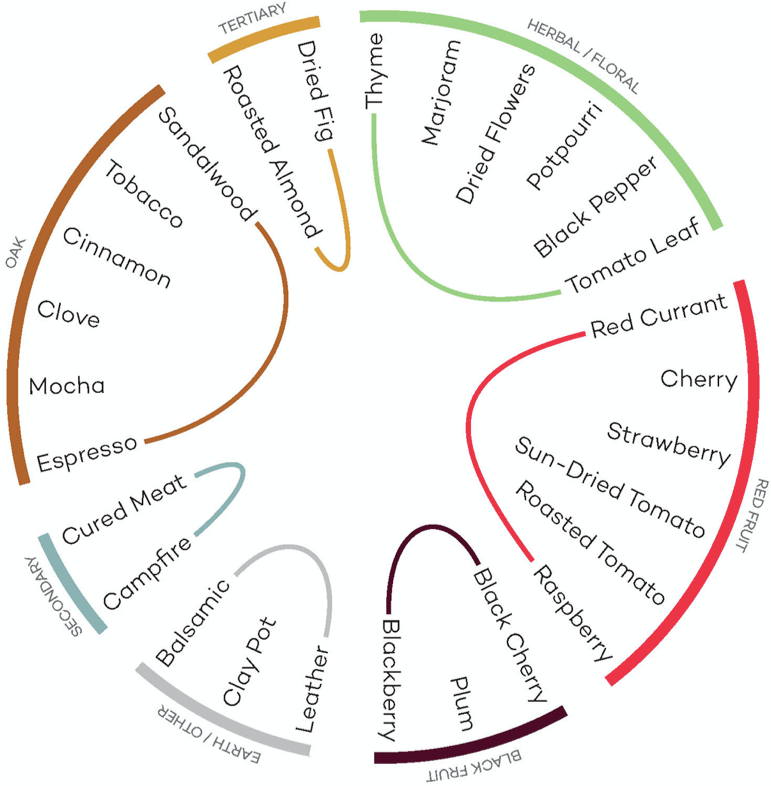
How Climate Affects Taste

12. Valpolicella Blend
Pronounced "val-polla-chellah". Aka Amarone. Orignates from Veneto of Italy & is now grown in Corvina, Rondinella, Corvinone, Molinara & elsewhere (192,000 acres). Red glass at cellar temperature is recommended. Drink-by-date is up to 5 years. Moderate costing at USD $15 to $20.
4 main grapes of Valpolicella: Corvina & Corvinone (highest quality wines; spicy red fruit & green almond flavours), Rondinella (Adds floral aromas & has low tannin), Molinara (high acidity)
5 quality levels from lowest to highest: Valpolicella Classico (tart cherry & ash), Valpolicella Superiore (dark berries & high acidity), Valpolicella Superiore Ripasso (cherry sauce, green peppercorn & carob), Amarone Della Valpolicella (black cherry, fig, sassafras, chocolate & brown sugar), Recioto Della Valpolicella (sweet black raisin, black cherry, clove & roasted hazelnut)
Some Ripasso tastes similar to Amarone at a fraction of the price. Amarone & Recioto are made with the apassimento method; grapes are dried on straw mats over the winter to concentrate sugars, then are pressed & ferments very slowly. Resulting wines are light in colour but rich in body & flavour.
Profile

Dominant Flavours

Possible Flavours

How Climate Affects Taste of Vintage

13. Zinfandel
Pronounced "zin-fan-dell". Aka Primitivo, Tribidrag. Originates from Croatia & is now grown in USA, Italy & elsewhere (81,000 acres). Red glass at room temperature is recommended. Drink-by-date is up to 2 years. Between cheap & moderate costing at USD $10 to $15.
2 regions: California (best Zinfandel grows in hills of Napa, Sonoma, Paso Robles & Sierra
Foothills. Exceptional old vineyards can be found in Lodi), Italy (In Puglia, most Primitivo is lighter in style. Wine in Manduria has more depth & is often blended with Negroamaro)
2 common styles: Red Fruits & Spice (lighter style with lower alcohol ~13.5% has raspberry, rose petal, spice cake, sage & black pepper flavours), Jam & Smoked Caramel (rich style with higher alcohol ~15% offers blackberry, cinnamon, caramel, jam, chocolate & smoky tobacco flavors)
Zinfandel naturally produces a rich red wine; however, only ~15% of US production is dedicated to this style. The rest goes into sappy-sweet rosé called White Zinfandel.
Profile

Dominant Flavours

Possible Flavours

How Climate Affects Taste

v
(viii) Full-Bodied Red Wine
Typically has high tannin, opaque ruby colour from high anthocyanin content & rich fruit flavours. Bold wines like these can be enjoyed on their own / with equally bold-flavoured foods.
Method:

1. Aglianico
Pronounced "ali-yawn-nico". Aka Taurasi. Originates from Southern Italy & is now grown in Italy & elsewhere (25,000 acres). Oversized glass at room temperature is recommended. Drink-by-date is up to 15 years. Between moderate & expensive costing at USD $20 to $30.
4 Aglianico wines: Aglianico Del Vulture (Flavours of blackberry sauce, licorice & smoke. 100% Aglianico from Mount Vulture in Basilicata), Aglianico Del Taburno (Flavours of black cherry, dried cranberry, cocoa powder, allspice & smoke. 100% Aglianico from the Taburno Mountains in Campania), Taurasi (Flavours of black raspberry, smoked meats & cigar. Look for wines ~ 10 years of age), Irpinia, Beneventano & Campania (Flavours of black fruits, green
herbs & charcoal. Larger encompassing regions offer value alternatives. Have a decanter handy)
Wines have deep colour, high tannin & acidity. Considered as one of the classic wines of Southern Italy. Decanting improves taste of bold red wines. Decant Aglianico for at least 2 hours.
Profile
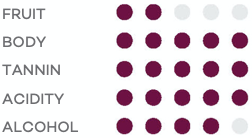
Dominant Flavours

Possible Flavours

How Climate Affects Taste of Vintage
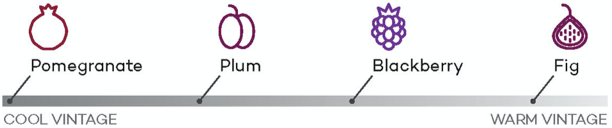
2. Bordeaux Blend
Pronounced "bore-doe". Aka Meritage, Cabernet-Merlot. The Blend comprises of Cabernet Sauvignon, Merlot, Cabernet Franc, Petit Verdot, Malbec, Carménère & others (~ 1.7 million acres). Oversized glass at room temperature is recommended. Drink-by-date is up to 10 years. Moderate costing at USD $15 to $20.
Regional taste differences: Blackberry, Menthol & Cedar (Expect ripe black fruit with
undertones of menthol, chocolate & allspice. Wines may be bolder with riper-tasting tannin; Paso Robles & Napa in California, Australia, Mendoza of Argentina, South Africa, Tuscany of Italy, Spain), Black Cherry, Violet & Bay Leaf (Expect tart black & red fruit flavours with undertones of violet, black pepper & bay leaf. Wines may taste lighter due to higher acidity; Bordeaux, South West France, Chile, Veneto, Washington, Coastal Sonoma of California, Mendocino of California)
Blends dominated by Cabernet Sauvignon typically have grippier tannin & green peppercorn notes, whereas Merlot blends have smoother tannins & more red fruit notes.
Profile

Dominant Flavours

Possible Flavours

How Climate Affects Taste

3. Cabernet Sauvignon
Pronounced "cab-er-nay saw-vin-yawn". Originates from France & is now grown in France, Chile, USA, Australia, Spain, China, Argentina, Italy, South Africa & elsewhere (717,000 acres). Oversized glass at room temperature is recommended. Drink-by-date is up to 10 years. Between moderate & expensive costing at USD $20 to $30.
Regional taste differences: Black Fruits, Black Pepper & Cocoa Powder (Warm climate regions lend to more fruit-forward wines with higher alcohol & ripe-tasting tannin; California, Australia, Argentina, South Africa, Central & Southern Italy, Spain), Red Fruits, Mint & Green Peppercorn (Cool-climate Cabernet tends to exhibit red fruit flavours & a lighter body; Bordeaux, Chile, Northern Italy, Washington, Northern California)
Cabernet Sauvignon is a natural cross between Cabernet Franc & Sauvignon Blanc that first
appeared in Bordeaux in the mid-1600s. It is now the most planted wine grape in the world.
Profile

Dominant Flavours

Possible Flavours

How Climate Affects Taste

4. Malbec
Pronounced "mal-bek". Originates from South West France & is now grown in Argentina, France, Chile, USA, South Africa, Australia, Italy & elsewhere (101,000 acres). Standard red glass at room temperature is recommended. Drink-by-date is up to 2 years. Between cheap & moderate costing at USD $10 to $15.
2 common styles: Basic Malbec (A juicy style of Malbec with dominant red fruit flavours & balanced tannin & is made with little to no oak aging), Reserva Malbec (Higher-end Malbec wines tend to age in oak longer & offer black fruit, chocolate, sweet tobacco & subtle notes of wild iris)
Argentina produces over 75% of the world’s Malbec wines. Majority of Malbec in Argentina comes from around Mendoza, with the best wines coming from the high-elevation subregions of Uco Valley & Lujan de Cuyo. In Argentina, altitude is a key quality indicator for Malbec. Higher-elevation Malbec will have higher acidity, more tannin & additional flower & herb notes. In France, Malbec is mostly from Cahors in the South West region; with a more earthy profile. It is much different than Argentine Malbec. Expect higher tannin & flavours of red & black currant, smoke & licorice.
Profile

Dominant Flavours

Possible Flavours

How Climate Affects Taste

5. Mourvèdre
Pronounced "moore-ved". Aka Monastrell, Mataro. Originates from Spain & is now grown in Spain, France, Australia, USA, South Africa & elsewhere (173,000 acres). Red glass at room temperature is recommended. Drink-by-date is up to 10 years. Between cheap & moderate costing at USD $10 to $15.
3 regions: Spain (Called Monastrell in Spain. Found in Valencia, Jumilla, Yecla, Almansa & Alicante), France (Single-varietal Mourvèdre wines are labeled “Bandol,” an appellation in Provence), Australia (Called Mataro. Found in South Australia, where it is used in GSM blends)
Most commonly used as a blending grape, and is the “M” in the Rhône/GSM blend. Adds colour, tannin structure & black fruit flavours.
Bottles of Spanish Monastrell are of superb value & do not require aging. Decant Monastrell for at least 1 hour. In Spain, Monastrell is used in Cava to make sparkling rosé. In France, Mourvèdre is also made into a non-sparkling rosé.
Profile

Dominant Flavours

Possible Flavours

How Climate Affects Taste

6. Nebbiolo
Pronounced "nebby-oh-low". Aka Barolo, Barbaresco, Spanna, Chiavennasca. Originates from Northern Italy & is now grown in Italy, Mexico, Argentina, Australia, USA & elsewhere (14,800 acres). Aroma collector glass at cellar temperature is recommended. Drink-by-date is more than 15 years. Expensive costing at USD +$30.
2 regions that contain 70 to 100% Nebbiolo: Piedmont (Barolo, Barbaresco, Nebbiolo Dalba, Langhe Nebbiolo, Roero, Gattinara, Carema, Ghemme), Lombardy (Valtellina & Sforzato)
Nebbiolo is considered one of Italy’s top red wines. More famously known by the names of its 2 top regions: Barolo & Barbaresco. Nebbiolo wines are pale-colored & aromatic (features of a light-bodied wine) but, since Nebbiolo is naturally high in tannin, it can be characterised as a full-bodied red. Nebbiolo wines improve with age & reveal subtle molasses, fig & leather flavours. Wines labeled as “Langhe Nebbiolo” offer exceptional value on good vintages.
Profile

Dominant Flavours

Possible Flavours

How Climate Affects Taste of Vintage

7. Nero D'Avola
Pronounced "nair-oh davo-la". Aka Calabrese. Originates from Sicily of Italy & is now grown in Italy & elsewhere (41,000 acres). Oversized glass at room temperature is recommended. Drink-by-date is up to 10 years. Moderate costing at USD $15 to $20.
Nero d’Avola is the most planted red variety in Sicily. It has very bold sweet fruit flavours & often a subtly sweet smoky finish. Quality Nero d’Avola wines are often described as having red fruit, black pepper, licorice & spice cake flavours. Spicy pepper flavours in Nero d’Avola become smoother with an hour of decanting. Other Sicilian red wines with the candied red fruit flavours of Nero d’Avola include Frappato & Nerello Mascalese. Pair Nero d’Avola with oxtail soup, beef and barley stew / bacon burgers. Dishes with gamy & meaty flavours will bring out the wine’s bright, sweet fruit flavours.
Profile

Dominant Flavours

Possible Flavours

How Climate Affects Taste of Vintage

8. Petit Verdot
Pronounced "peh-tee vur-doe". Originates from France & is now grown in Spain, France, Australia, USA, South Africa, Chile, Argentina & elsewhere (17,800 acres). Oversized glass at room temperature is recommended. Drink-by-date is up to 5 years. Moderate costing at USD $15 to $20.
3 regions: Spain (Found in Castilla-La Mancha where it adds dark fruit flavours to Bordeaux blends), Bordeaux of France (Classic “Left Bank” Bordeaux blend has ~ 1 to 2% Petit Verdot), Australia & USA (Single-varietal Petit Verdot wines taste of blueberry, vanilla & violets)
Petit Verdot is highly desired as a blending grape with its deep purple colour, high tannin & floral aromas. Petit Verdot is most commonly used in Bordeaux blends. Petit Verdot in Spain & Australia have sunny conditions to properly ripen the grape. Bolder Bordeaux blends: wines with a higher proportion of Petit Verdot and/or Petite Sirah.
Most famous Chilean Carménère; “Purple Angel” adds 10% Petit Verdot to embolden the wine with notes of dark fruit, chocolate & sage.
Profile

Dominant Flavours

Possible Flavours

How Climate Affects Taste

9. Petite Sirah
Pronounced "peh-teet sear-ah". Aka Durif, Petite Syrah. Originates from France & is now grown in USA & elsewhere (9,800 acres). Red glass at room temperature is recommended. Drink-by-date is up to 5 years. Between cheap & moderate costing at USD $10 to $15.
Petite Sirah is the offspring grape of Syrah & a rare black grape from South West France called Peloursin. Today, Petite Sirah grows primarily in California, where it’s often used
to add body to Cabernet Sauvignon & Zinfandel. Petite Sirah is one of the best values for full-bodied red wine. Look for wines with extended oak aging / a small % of Zinfandel, which acts to soften the high tannin. Petite Sirah & other opaque, high-tannin red wines contain 2 to 3 times as many antioxidants as light, translucent red wines like Zinfandel & Gamay. Petite Sirah tastes great with rich braised meats, barbecue, casseroles & meaty pasta dishes.
Profile

Dominant Flavours

Possible Flavours

How Climate Affects Taste of Vintage

10. Pinotage
Pronounced "pee-no-taj". Originates from South Africa & is now grown in South Africa & elsewhere (16,000 acres). Red glass at room temperature is recommended. Drink-by-date is up to 5 years. Moderate costing at USD $15 to $20.
Pinotage is the most planted red grape in South Africa. Pinotage tastes nothing like either of its progenitors. It is an enigma. Look for Pinotage with descriptions of both red & black fruit flavours, a hint that suggests a wine with more balance & complexity. Avoid low-quality bulk Pinotage as they may have a pungent note of tar & nail polish remover; a sign of volatile acidity. Similar wines include Australian Shiraz & American Petite Sirah.
Profile

Dominant Flavours

Possible Flavour

How Climate Affects Taste of Vintage

11. Syrah
Pronounced "sear-ah". Aka Shiraz. Originates from France & is now grown in France, Australia, Spain, Argentina, South Africa, USA, Italy, Chile, Portugal & elsewhere (459,000 acres). Red glass at room temperature is recommended. Drink-by-date is up to 10 years. Between cheap & moderate costing at USD $10 to $15.
Regional taste differences: Fruit-forward Blackberry, Blueberry & Sweet Tobacco (Full-bodied wines with fruit-forward flavours of blackberry, blueberry, sweet tobacco smoke, chocolate, baking spices & vanilla; California, South Australia, Spain, Argentina, South Africa), Savoury Plum, Olive & Green Peppercorn (Medium- to full-bodied wines with savoury flavours of plum, olive, boysenberry, leather, green peppercorn, bacon fat & cocoa powder; Rhône. of France, Columbia Valley of Washington, Victoria of Australia, Western Australia, Chile)
Regions of single-varietal Syrah: South Australia, Northern Rhône, California, Columbia Valley)
Regions of blended Syrah (with other varieties): Côtes Du Rhône of France, Languedoc-Roussillon of France, Castilla-La Mancha of Spain, Extremadura of Spain, Catalonia of Spain, Valencia of Spain, Aragon of Spain)
Profile

Dominant Flavours

Possible Flavour

How Climate Affects Taste of Vintage

12. Tempranillo
Pronounced "temp-rah-nee-oh". Aka Cencibel, Tinta Roriz, Tinta de Toro, Rioja, Ribera del Duero. Originates from Spain & is now grown in Spain, Portugal, Argentina, France, Australia & elsewhere (575,000 acres). Red glass at cellar temperature is recommended. Drink-by-date is up to 10 years. Moderate costing at USD $15 to $20.
Regional wines: La Rioja (Rioja), Castilla y León (Ribera Del Duero, Cigales, Toro), La Mancha (Valdepeñas), Extremadura (Ribera Del Guadiana)
4 ageing terms: Roble / Tinto (Little to no oak ageing), Crianza (~6 to 12 months aging in oak), Reserva (12 months oak aging with up to 2 years of bottle aging), Gran Reserva (~18 to 24 months oak aging with up to 4 years of bottle aging)
3 common styles: Young; Roble / Crianza (Juicy red fruit flavors, herbs, & a spicy kick), Some Ageing; Reserva (Red & black fruit flavours, dried roses & baking spices), Long Ageing; Reserva+ (Dried red and black fruits, fig, cinnamon & cedar flavours with notes of leather & dusty dry leaves)
Profile

Dominant Flavours

Possible Flavour

How Climate Affects Taste of Vintage

13. Touriga Nacional
Pronounced "tor-ree-gah nah-see-un-nall". Originates from Portugal & is now grown in Portugal & elsewhere (26,000 acres). Oversized glass at room temperature is recommended. Drink-by-date is up to 5 years. Moderate costing at USD $15 to $20.
3 regions: Douro (Expect flavours of blueberry, black currant, violets, vanilla, & subtle notes of roasted meat. Wine is structured with fine gravelly tannins), Dão (Cooler & higher elevation than Douro & produces wines with more red fruit flavours, bergamot & violet supported by spicy acidity), Alentejo (Rich but juicy style with black and red fruit, violet, licorice & usually a touch of vanilla from oak aging)
Touriga Nacional is a deeply coloured red wine grape from Douro Valley of Portugal. Characterised by lush black fruit flavours, bold tannin & a subtle floral aroma of violets.
Profile

Dominant Flavours

Possible Flavour

How Climate Affects Taste of Vintage

(ix) Dessert Wine
Range in style from off-dry to very sweet. Sweetest & highest acidity of these dessert wines can be cellared for many years to develop subtle nutty flavours. Some dessert wines are stabilised with brandy (fortification). Fortified wines have high alcohol & can store open for up to a month.
Types of Dessert Wines:

1. Madeira

2. Marsala

3. Port

4. Sauternais

5. Sherry

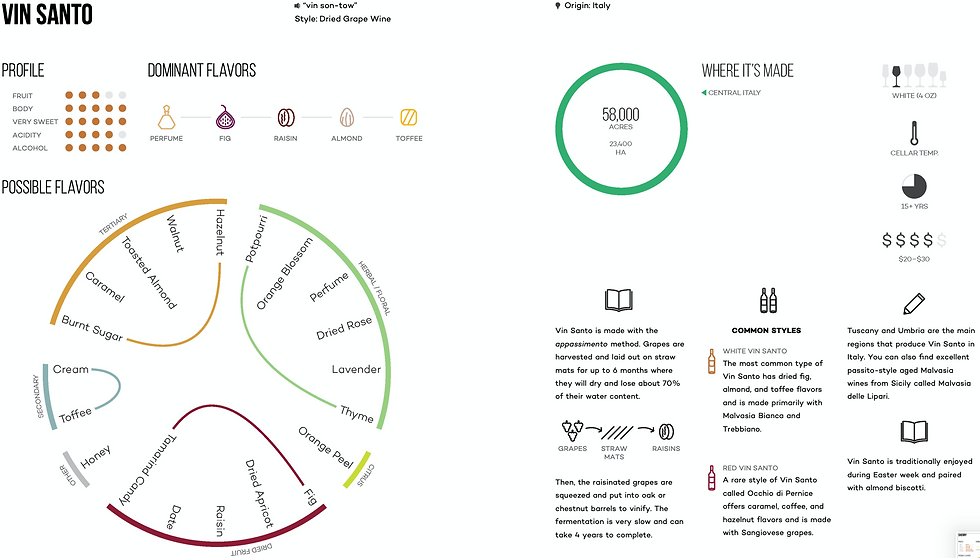
6. Vin Santo
Sources:
https://winefolly.com/wine-basics-beginners-guide/
https://winefolly.com/deep-dive/what-is-wine/
https://winefolly.com/wine-folly-the-essential-guide-to-wine-book/
Comments