


Interior Design
- Nov 1, 2020
- 68 min read
Updated: Nov 17, 2020
Study of interior spaces created by structures & shells of buildings
Disclaimer: Content is summarised from Chapter 1 - 3 of 'Interior Design Illustrated' 4th Edition by Francis D. K. Ching & Corky Binggeli
Contents:
1. Interior Space
• Defining Space
• A Building's Physical Systems
• Basic Linear Structural Elements
• Basic Planar Structural Elements
• Volumetric Structural System
• Perception of Space • 1st Dimension of Interior Space: Width
• 2nd Dimension of Interior Space: Length
• 3rd Dimension of Interior Space: Height
• Relating Interior Space to Other Spaces • Altering Space
• Conclusion
• Summary
2. Interior Design
• The Design Process
• Criteria to Measure Effectiveness of Solution
• Sustainable Design Rating Systems & Standards
• Fits Between Interior Space & Our Bodies
• Designing for Specific Groups
• Territorial Spaces
• Specific Spaces
• The Programming Process • Requirements
• Space Planning
• Desired Qualities
• Desired Relationships • Types of Plan Arrangements
• Drawings
• Tech
• Summary
3. Design Vocabulary
• Perceptions
• Form: Point, Line, Plane & Volume
• Shapes
• Texture
• Colour
• Organising Elements
• Summary
1. Interior Space
1.1 Defining Space
Space is the quintessential element in interior design. Via space, we move; see forms, hear sounds, feel gentle breezes, warmth of the sun & smell fragrances of flowers in bloom.
Geometric elements (point, line, plane & volume) articulate & define space. They become linear columns, beams, planar walls, floors & roofs.

A building's form, scale & spatial organisation are response to conditions like: functional planning requirements, technical aspects of structure & construction, economic realities, expressive qualities of image & style and physical context of its site & exterior space.
To determine where a building should be situated, the potential relationship between interior & exterior space is considered.

Exterior walls constitute interface between interior & exterior environments. Thick & heavy: shows clear distinction between a controlled interior environment & exterior space. Thin / transparent: attempts to merge inside & outside.

Windows & doorways are spatial transitions between exterior & interior space.
Special transitional spaces belong to the outside & inside world & can mediate between both worlds. E.g. porch, veranda, arcaded gallery.

Entering a building, we sense shelter & enclosure due to the bounding floor, wall & ceiling planes of interior space. They enclose space, articulate its boundaries & separate it from adjoining interior spaces & the outside.
Terms like grand hall, loft space, sun room & alcove describe a space's size, scale, lighting, nature of its enclosing surfaces & way it relates to adjacent spaces.

Understand how interior space is formed by building systems of structure & enclosure to choose to work with, continue, or even offer a counterpoint to the essential qualities of an architectural space.

1.2 A Building's Physical Systems
(a) Structural System
Structural system is formed by geometry of materials & how they react to forces applied. Superstructure: vertical extension of the foundation system. Consists of columns, beams & load-bearing walls that support floor & roof structures.
Foundation: forms base of a building, anchors it firmly to the ground & supports building elements & spaces above.
Both systems work together to support these loads:
Dead Loads: Determined by how a building is constructed. A static vertical load comprising weight of its structural & nonstructural components, including any equipment permanently attached to the structure.
Live Loads: Determined by how a building is used. A movable / moving load comprising weight of its occupants & any mobile equipment & furnishings. In cold / wet climates, collected snow & water imposes additional live load.
Dynamic Loads: Determined by where a building is located. Potential to bear a dynamic load can change suddenly due to forces of wind & earthquakes.


(b) Enclosure System
Building envelope consists of exterior protection & sheltering interior spaces from exterior environment.
Interior walls, partitions & ceilings subdivide & define interior space. They are mostly nonstructural in nature & carry no loads other than their own weight.

(c) Building Services
Mechanical systems provide services like heating, ventilation & air-conditioning.
Plumbing systems supply water for human consumption, firefighting & disposal of waste.
Electrical systems controls & safely distributes power.

1.3 Basic Linear Structural Elements
Linear structural systems are cumulative by nature & eminently flexible. They allow for growth, change & adaptation of individual spaces to their specific uses.

Column
Vertical support that transmits compressive forces downward along its shaft.

Beam
Horizontal support that transmits forces perpendicular to itself along its length to its supports. Are subject to bending. Increasing depth --> to span greater distances.


Floor, wall & ceiling planes are necessary for support & enclosure of interior space. Floor & ceiling planes define vertical limits of space. May consist of planar slabs / hierarchical arrangement of girders (large primary beams) & beams and joists (series of smaller, parallel beams).
Walls & partitions need not be load-bearing & do not have to be aligned with columns of a structural frame, except where serving as shear walls & providing for lateral stability. Defines horizontal dimensions of space according to need, desire / circumstance.


1.4 Basic Planar Structural Elements
Load-bearing wall
Window & door openings within a bearing wall tend to weaken its structural integrity. Any opening is spanned by an arch / short beam (lintel) to support wall load above & allow compressive stresses to flow around opening to adjacent sections of the wall. For lateral stability, pilasters & cross walls are often used.
Planar elements like bearing walls define physical limits of space & provide a sense of enclosure, privacy & serve as barriers against the elements.

Horizontal slab
Horizontal, rigid, usually monolithic plate. E.g. reinforced concrete slab. Able to support concentrated & distributed loads as resulting stresses can fan out across plane of slab & take various paths to slab supports. Can be supported by beams & columns / masonry / concrete bearing wall.

When supported along 2 edges, slabs can be considered a wide, shallow beam extending in 1 direction. Supported along 4 sides, a slab is a 2-way structural element. For greater efficiency & reduced weight, a slab can be modified in sections to incorporate ribs.
When connected with reinforced concrete columns, flat slabs can be supported without beams. They form horizontal layers of space punctuated by shafts of supporting columns.

1.5 Volumetric Structural System
Consists of a 3-D mass. Mass of material occupies void of space. Volume of interior space is carved out of mass. Efficiency of engineering methods & strength of modern building materials have limited use of pure volumetric structural systems, though 3-D computer design is changing this; E.g. Walt Disney Concert Hall designed by Frank Gehry.

At a small scale, stone & clay masonry units are volumetric structural elements. At a larger scale, any building that encloses interior space are 3-D structures that must have strength in width, length & depth.
Composite systems combine linear, planar & volumetric elements into 3-D compositions of form & space. Most structural systems are composites. Each presents advantages & disadvantages, depending on size, location & intended use of a building. Be aware of character of interior spaces that each system defines.


1.6 Perception of Space
Selection & arrangement of interior elements develop visual relationships that define & organise interior space of a room. Non-load-bearing partitions & suspended ceilings are often used to define / modify space within structural framework / shell of a building.

Colour, texture & pattern of wall, floor & ceiling surfaces affects perception of their relative positions in space & our awareness of the room's dimensions, scale & proportion. Within a large space, form & arrangement of furnishings can divide areas, provide a sense of enclosure & define spatial patterns.
Lighting & light-dark patterns it creates, call our attention to 1 area, deemphasise others & create divisions of space.

Soft, absorbent surfaces muffle sounds & can diminish our awareness of physical dimensions of a room. Hard surfaces that reflect sounds help to define its physical boundaries. Echoes suggest a large volume.
Space is also structured by nature of our activities as it affects how we plan, arrange & organise interior space.

Interior spaces are formed by a building's structural system, then defined by wall and ceiling planes & related to other spaces by windows and doorways. Every building has a recognisable pattern of these elements and systems. Each pattern has an inherent geometry that molds / carves out a volume of space into its likeness.
It is useful to be able to read this figure-ground relationship between the form of space-defining elements & that of the space defined. Either structure / space can dominate this relationship.
It is useful to see alternating figure-ground dominance occurring as interior design elements like tables & chairs are introduced & arranged.
A chair in a room occupies space & also creates a spatial relationship between itself & surrounding enclosure. Recognise form of the chair & form of the space surrounding the chair after it has filled some of the void. As more elements are introduced into the pattern, spatial relationships multiply.


Dimensions of interior space, like spatial form, are directly related to nature of a building's structural system: strength of materials & size and spacing of its members.
Dimensions of a space, in turn, determine a room's proportion, scale & influence the way it is used.
1.7 1st Dimension of Interior Space: Width
This horizontal dimension of space has traditionally been limited by materials & techniques. With economic resources of today, almost any architectural structure is technically possible. Wood / steel beams & concrete slabs span up to 9 m. Wood / steel trusses span up to 30 m / more. Longer roof spans are possible with space frames & a variety of curved structures, like domes, suspension systems & membranes supported by air pressure.

Computer-aided design (CAD) & building information management (BIM) software allow designers to build interactive 3-D computer models of buildings & coordinate building systems as they design.
3D CAD systems can provide higher productivity, rapid generation of design alternatives & removal of errors that result from disparities between different drawings. But, these systems do require special design & management skills.
1.8 2nd Dimension of Interior Space: Length
This horizontal dimension of space is limited by desire & circumstance.
Square Space
Rare, it is static in quality & often formal in character. Equality of 4 sides focuses our attention in on the room's center. This centrality can be enhanced / emphasised by covering the space with a pyramidal / dome structure.
Pyramids & domes can emphasise the centrality of square spaces.

Architectural elements like windows & stairways can deemphasise centrality of a square spaces.

Rectangular Space
Eminently flexible. Its character & usefulness are determined by proportion of width to length, configuration of its ceiling, pattern of its windows & doorways, and its relationship to adjacent spaces.
When length of a space is greater than twice its width, it tends to dominate & control room's layout & use. Given sufficient width, space can be divided into separate but related areas.
A space whose length greatly exceeds width encourages movement along its long dimension. Makes them suitable for gallery spaces / connectors of other spaces.

Altering Space
Square & rectangular spaces can be altered by extension / addition / subtraction / merging. These can create an alcove space / reflect an adjoining element or site feature

Curvilinear Spaces
Rectangular spaces are the norm. Curvilinear spaces are usually reserved for special circumstances. But, 3D CAD systems have made design & construction of curvilinear spaces more feasible.
Simplest curvilinear space is a circular one. It is compact & self-centering. Though it creates a focus on its center, a circular space also relates to surrounding space equally in all directions. It has no front, back, or sides, unless these are defined by other elements.
An elliptical space is more dynamic, having 2 centers & unequal axes.
Freeform curvilinear spaces are circular / elliptical spaces that have been combined in an overlapping manner.

In a rectilinear context, a curvilinear space is highly visible. Its contrasting geometry can express importance / uniqueness of its function. It can define a freestanding volume within a larger space. It can serve as an organising element about which other rooms are gathered. It can articulate the edge of a space & reflect an exterior condition of the building site.

Curved walls are dynamic & visually active, leading our eyes. Concave aspect encloses & focuses space inward, while its convex aspect pushes space outward.
With curvilinear spaces, consider integration of furniture & other interior elements. We need to resolve conflicting geometries by: (a) arrange interior forms as freestanding objects within curvilinear space (b) integrate the form of built-in furniture & fixtures with curved boundaries of the space.

1.9 3rd Dimension of Interior Space: Height
Height is established by the ceiling plane. It is as influential as horizontal dimensions of a space in forming spatial quality of a room.
We can more accurately sense relationship between height of a space & our own body height. Thus, a measurable change in height of a ceiling seems to have a greater effect on our impression of a space than a similar change in width / length.

High ceilings are often associated with feelings of loftiness / grandeur. Low ceilings may connote cavelike coziness & intimacy. Lowering part of a ceiling can foster intimacy, modify acoustics or add visual texture. Interior soffits, canopies & clouds partially lower a ceiling at its perimeter / over areas of interest.
A ceiling defined by the floor plane of the room above it is typically flat. A ceiling created by a roof structure can reflect its form & manner in which it spans the space. Shed, gable & vaulted ceiling forms give direction to space.

1.10 Relating Interior Space to Other Spaces
Doorways
Although individual spaces may be designed & formed for a certain purpose, they are gathered together within a building as they are functionally related / are used by a common group of people / share a common purpose. How interior spaces are related is determined by their relative position in a building's spatial pattern, the nature of the spaces that connect them & boundaries they have in common.
Floor, wall & ceiling planes define & isolate a portion of space. The wall plane, being perpendicular to our normal line of sight, has the greatest effect as a spatial boundary. It limits our visual field & serves as a barrier to our movement. Openings created within the wall plane for windows & doorways reestablish contact with surrounding spaces.

Doorways provide physical access from one space to another. When closed, they shut a room off from adjacent spaces. When open, they establish visual, spatial & acoustical links between spaces. Large open doorways erode integrity of a room's enclosure & strengthen its connection with adjacent spaces / outdoors.
Thickness of walls separating 2 spaces is exposed at a doorway. It determines degree of separation we sense as we pass through the doorway. Scale & treatment of doorway itself provide visual clues to nature of space being entered.
Number & location of doorways along a room's perimeter affect our pattern of movement within the space & ways we may arrange its furnishings & organise our activities.
Widths of door openings affect ease of movement for people & furnishings. A 914-mm wide doorway is reduced to about 813 mm when thickness of open door & that of its hardware are accounted. Openings of less than 813 mm are barriers to wheelchairs, affecting accessibility, visitability & aging-in-place.


Windows
Let light & air into the interior space & provide views of the outdoors. Size & placement relative to wall plane affects degree of separation between an interior space & exterior environment. Views to outside & natural ventilation are important for sustainable design.
Windows framed within a wall plane attract our attention with their brightness & outlook but maintain enclosure provided by the wall. Large windows & glass walls attempt to visually merge indoor & outdoor space. Visual treatment of window frames in each case can either emphasise / minimise perceived limits of interior space.
Interior windows can visually expand a room beyond its physical boundaries & allow it to become an integral part of surrounding interior space.


Stairways
Exterior set of steps leading to a building's entrance can serve to separate private domain from public passage & enhance the act of entry into a transitional space like a porch / terrace. Entrances without steps support visitability & aging-in-place.
Interior stairways connect various levels of a building. Manner shapes our movement in space: how we approach a stairway, pace & style of our ascent / descent & what we have an opportunity to do along the way. Wide, shallow steps serve as an invitation. Narrow, steep stairway may lead to more private places. Landings that interrupt a flight of steps can allow a stairway to change direction & give us room for pause, rest & outlook.

Designers are becoming more concerned with creating opportunities for movement within interior workplace spaces. E.g. increasing use of wide stairs as seating areas, often connecting work / presentation spaces.
Active design focuses dealing with urgent health crises of obesity & diabetes. They seek to increase stair use by providing a conveniently located stair for everyday use, posting motivational signage to encourage stair use & designing visible, appealing, and comfortable stairs.
Space a stairway occupies can be considerable, but its form can be fit into an interior in several ways. It can fill space, define edges, be used as a seating or sculpture.
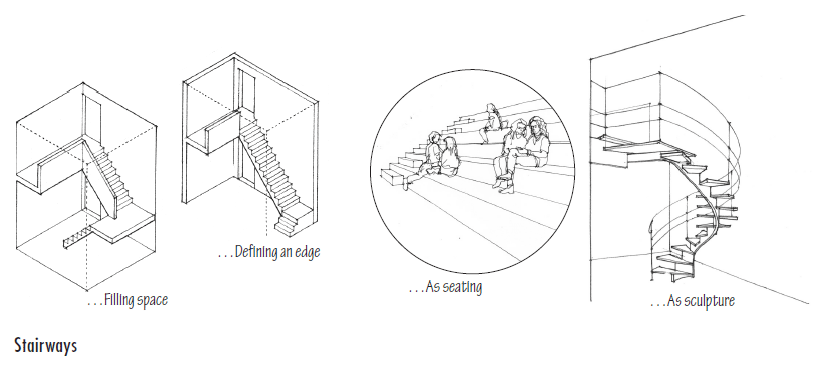
1.11 Altering Space
Architectural planning & design considers: (a) nature of activities housed (b) spatial requirements for form, scale & light (c) desired relationships among various interior spaces. Modifications are used where a misfit occurs in an existing building & activity requirements. Adaptive reuse: design involves changes in building's use. Reusing existing buildings preserves historic qualities & architectural character of a built environment.
Major types of alteration considered: 1. Structural changes in boundaries of interior space 2. Nonstructural modifications & enhancement accomplished via interior design.
Acceptance of formerly forbidden accessory dwelling units (ADUs): create residential units in existing owner-occupied one- to three-family buildings in certain neighbourhoods. ADUs create an opportunity to evolve older residences to meet 21st-century housing needs, while promoting long-term occupancy & neighbourhood stability.
Structural change may involve removing / adding walls to alter shape & rearrange pattern of existing spaces / to add on new space. Note the distinction between load-bearing walls & non-load-bearing partitions while performing such alterations.


Windows may be enlarged / added for better daylighting / take advantage of a view. Doorway may be moved / added for better access to room space / improve movement paths. Large doorway may be created to merge 2 adjacent spaces. Any new / enlarged opening in a load-bearing wall requires a lintel / header sized to carry the wall load above the opening.

To add a stairway, daylight a space with skylights, or create a vertical relationship between two levels of space, structural changes in floor / ceiling plane may be required. Alterations in these horizontal structures of a building may require that the edges of any new openings be reinforced & supported by a system of beams, columns, posts, or bearing walls.


1.12 Conclusion
Always note the overall structure & patterns of the architecture. Any changes in physical boundaries of a space must be carefully planned to not disturb the structural integrity of a building. Major structural changes in a space thus require assistance of a professional engineer / architect.
Structural changes alter physical boundaries of space. Nonstructural alterations are based on how we perceive, use & inhabit space.

1.13 Summary
1. Space is of utmost importance. Geometric elements (point, line, plane & volume) articulate & define space. They become linear columns, beams, planar walls, floors & roofs which support & enclose interior space.
2. Physical systems of a building: structural, enclosure & building services.
3. Structural systems are modified architecturally / by interior design. Consists of foundation & superstructure to support dead, live & dynamic loads. Superstructures consist of columns, beams & load-bearing walls.
4. Enclosure system protects interior space from exterior environment. Interior walls, partitions & ceilings define interior space. They are nonstructural in nature. (Carries no loads but itself)
5. Building services are mechanical, plumbing & electrical systems for essential services.
6. Most structural systems are composites. Composite systems combine linear, planar & volumetric elements into 3-D compositions of form & space.
7. Linear structural system consists of columns & beams. Allows for growth, change & adaptation of individual spaces to specific uses. Columns are vertical supports that transmit compressive forces down along its shaft. Beams are horizontal supports that transmit forces perpendicular to themselves along its length to its supports.
8. Planar structural system consists of load-bearing walls & horizontal slabs. Load-bearing walls with openings are structurally weakened. Thus they are spanned by arch / short beam (lintel) for support of wall load while pilasters / cross walls are for lateral stability. Horizontal slabs support concentrated & distributed loads. Can be supported by beams & columns / masonry / concrete bearing wall.
9. Colour, texture, pattern, use of light & nature of our activities can affect our perception of space. E.g. Lighting creates like-dark patterns calling our attention to 1 area, creating a division of space. E.g. Soft absorbent surfaces muffle sounds & diminish our awareness of physical dimensions of a room while hard surfaces reflect sounds to define physical boundaries & at its extreme, echoes suggest large volume.
10. Interior spaces are formed by a structural system, defined by wall & ceiling planes. It is related to other spaces by windows & doorways.
11. When interior design elements like chairs are arranged, either a structure / space can dominate. E.g. recognise form of the chair & form of the surrounding space: spatial relationship.
12. 3 dimensions of a space determine a room's proportion, scale & influence way it is used. (width, length & height)
13. Limits on width are reduced with CAD & BIM for 3D computer models.
14. Pyramid & dome structures can emphasise centrality of square spaces while windows & stairways can deemphasise it.
15. Rectangular spaces are the norm while curvilinear spaces are for special circumstances. Such spaces can be a circle, eclipse or freeform.
16. Curvilinear space is highly visible. Its contrasting geometry can express importance / uniqueness of its function.
17. Curved walls are dynamic & visually active, leading our eyes. Concave: encloses & focuses space inward. Convex: pushes space outward.
18. When integrating furniture with curvilinear spaces, to resolve conflicting geometries: (a) arrange interior forms as freestanding objects within curvilinear space (b) integrate form of built-in furniture & fixtures with curved boundaries of the space.
19. We more accurately sense relationship between height of a space & our own body's height. Thus a measurable change in height of a ceiling has a greater effect on impression of a space than a similar change in width / length.
20. High ceilings: feelings of loftiness / grandeur. Low ceilings: cavelike coziness & intimacy.
21. Doorways, windows & stairways relating interior space to other spaces.
22. Doorways provide physical access between spaces. When open, they establish visual, spatial & acoustical links between spaces. Large open doorways erode integrity of a room's enclosure & strengthen its connection with adjacent spaces / outdoors.
23. Windows provide light, air & views. Can frame views & show degree of enclosure / transparency.
24. Exterior stairways: separate private domain from public passage & enhance act of entry into a transitional space like a porch / terrace.
25. Wide, shallow steps serve as an invitation. Narrow, steep stairway may lead to more private places. Landings that interrupt a flight of steps can allow a stairway to change direction & give us room for pause, rest & outlook.
26. Stairways can fill space, define an edge, be used as a seating or as a sculpture.
27. Architectural planning & design considers: (a) nature of activities housed (b) spatial requirements for form, scale & light (c) desired relationships among various interior spaces. Modifications are needed with mismatch of an existing building & activity requirements.
28. Structural changes alter physical boundaries of space. Nonstructural alterations are based on how we perceive, use & inhabit space.
29. Major types of alteration considered: (a) Structural changes in boundaries of interior space (b) Nonstructural modifications & enhancement accomplished via interior design.
30. Structural change may involve removing / adding walls to alter shape & rearrange pattern of existing spaces / to add on new space.
31. Windows may be enlarged / added for better daylighting / take advantage of a view. Doorway may be moved / added for better access to room space / improve movement paths.
2. Interior Design
Planning, layout & design of interior spaces in buildings. Purpose: functional improvement, aesthetic enrichment & psychological enhancement of quality of life in interior spaces.
Interior Design of Today
Many projects today involve interior design of existing buildings, and the design of spatial, technical, cultural, and functional needs from the inside out. When designing new structures, the designer can consider future transformations. Concepts like sustainability & resiliency are also considered.
Historic preservation is highly desirable today in USA. Technological advantages like ground-penetrating radar, infrared thermography & drones with their cameras, open new frontiers for documentation of existing construction. New materials can conserve buildings by sealing masonry & concrete against water penetration, coat active cracks without themselves cracking and protect iron materials from corrosion. Older buildings can be modelled in 3D to determine their strengths & weaknesses.
Current trends include working with local artisans to produce unique furnishings that combine local materials with modern themes.
Resiliency
Ability of an organization, a place, or a family to weather a catastrophic event; climate, social unrest, & to come back better than it was before. Designed to evolve & adapt to changing conditions over time. A Perkins + Will report identified design strategies to address major crisis events: Green roofs as outdoor refuge spaces and food production, On-site renewable energy, Building elements above a flood plain, Transportation for building occupants, including public transportation, bicycles, and inflatable rafts, On-site storage of emergency supplies, Emergency communications, Shelter in place, Training for personnel, Communications with occupants.
Designing for Use
Designing for an aging population: simple & intuitive use is supported by wireless devices like thermostats, security systems, home media, lighting systems, baby monitors & wall ovens. Size & space for approach & use are accommodated by taller kitchen counters for tall residents / lower ones for children's areas. Pocket doors provide more room in tight bathrooms / closets & oversized showers work for pets, shower chairs, or portable baby tubs. An extra room space is flexible in use over time: children's play area, entertainment center, home office, guest room, first floor bedroom, private room for a live-in home health aide, or multi-generational living. Millennials are reshaping the design & development of interior space. Houses designed to age & adapt with homeowners' changing needs are getting more common. Clients are seeking homes that relate to their natural context & lifestyles of their occupants.
Office Spaces
WeWork, cites 5 factors for co-working spaces (June 2016):
(i) Warm up the lighting with connections to natural light. (ii) Create a spectrum of sound by providing multiple options in terms of energy level & noise, varying with activity level & mood. (iii) Feel at home with warm, inviting & comfortable spaces with a human connection to nature & natural materials. (iv) Rely on data by using concerted data analysis like user rating of spaces. (v) Pair unexpected activities by designing amenity hubs like putting printers & food in 1 area to keep people moving in & out of the space, encouraging them to stop & chat.
Office spaces are trying to mimic private & social spaces of residential architecture. Some spaces feel comfortable & cozy, others are more expansive & provide views. A more effective office has minimal private workspaces & more put into collaborative / unstructured spaces. Kitchens can become hearths of offices, as they are the home away from home. Dining rooms have become workspaces, balanced by low- / no-tech zones for personal interactions.
Gathering Information
Research on impacts of design by sociologists & healthcare experts show us how interior space impacts productivity & well-being. Interior designers can meet with the people who will be the users to understand how the design can meaningfully support them. Designers can act as liaisons with other professionals for more perspectives.
Healthcare Design
Healthcare facility design today focuses on patients, with evidence-based design (EBD) linking patient-centered design with improved patient & worker safety, patient outcomes, environmental performance & operational efficiency.
Collaboration
Interior designer may be a sole practitioner; collaborating with other designers, architects, & design specialists in a larger design firm; or serving as a consultant to an architectural firm. Interior designer will also work with client representatives like facilities managers, administrators & end users.

Interior designer is often the liaison between client & the sources for finishes / furnishings. User (e.g. a hotel's housekeepers) often sees critical elements that designers may miss. During construction, interior designer is also in contact with contractors & suppliers. Members of the design & construction team should maintain an atmosphere of communication, cooperation & mutual respect. Coordination allows expertise of each design field to be tapped to produce creative solutions to design problems as they arise. Complex challenges require knowledge disciplines like architecture & interior design, graphic & landscape design, structural, industrial, mechanical, acoustical, electrical & systems engineering, and fields like psychology, sociology & anthropology.

Design team includes in-house talent & specialised consultants, preferably from beginning of the design process. Interior designers are knowledge seekers within their own profession & other professions. Interior designers bring together people & abilities that deliver success for their clients by devising best possible solutions.
Awareness of cultural differences can be aided by multidisciplinary teams. Programs include consideration of human dignities like cleanliness, good food, safety, employment & community for people. Architecture & interior design works best when considered as one.
Interior designers determine which elements to use & how to arrange them via the process of design. Although presented as a linear series of steps, design process is more often a cyclical, iterative one where sequences of careful analysis, synthesis & evaluation of available info, insights, and possible solutions is repeated until a successful fit between what exists & what is desired is achieved.
2.1 The Design Process
Define the Problem
(i) Identify client needs: Who, what, when, where, how, why?
(ii) Set preliminary goals: (a) Functional requirements (b) Aesthetic image & style (c) Psychological stimulus & meaning.
Be able to define & understand the nature of a design problem. Definition should specify how the design solution should perform & what goals / objectives will be met.
Formulate Program
(i) What exists?: (a) Collect & analyse info. (b) Document physical / cultural context. (c) Describe existing elements.
(ii) What is desired?: (a) Identify user needs & preferences. (b) Clarify goals. (c) Develop matrices, charts & adjacency diagrams.
(iii) What is possible?: (a) What can / cannot be altered? (b) What can / cannot be controlled (c) What is allowed / prohibited? (d) Define limits: time, economic, legal & technical.
Design requires rational thought based on knowledge from experience & research. Intuition & imagination adds the creative dimension to the otherwise rational design process.
Approaches to generate ideas & synthesise possible design solutions: (i) Isolate 2 or more key issues of importance & develop solutions around them. (ii) Study analogous situations that could serve as models for developing possible solutions. (iii) Develop ideal solutions for parts of the problem, which could be integrated into whole solutions & tempered by the reality of what exists.
May 2016 Metropolis issue: students who sat & drew through free association for more than 45 minutes tend to become uncomfortable. But when instructed to push through this discomfort, they often entered a whole new direction for their work; a surprising response to their boredom. Being creative is often uncomfortable, even painful. For designers & artists, it is often the result of driving an inquiry down a new path & stumbling into the unknown. They discover new ways to conceptualise ideas in expansive, non-linear forms that go beyond traditional perceptual & cognitive divisions. When an idea fails, materials & processes can suggest alternate paths. This push can result in a moment of insight that teaches how to sustain & encourage creative breakthroughs.
Develop Concept
(i) Brainstorm ideas: (a) Diagram major functional & spatial relationships. (b) Assign values to key issues / elements. (c) Find ways to combine several good ideas into 1. (d) Manipulate the parts to see how a change might affect the whole. (e) Look at the situation from different points of view.
(ii) Draft a concept statement: Verbalise principal design ideas in a concise manner.
(iii) Develop schematic designs. (a) Establish major functional & spatial relationships. (b) Show relative sizes & shapes of important features. (c) Develop several alternatives for comparative study
Assess Alternatives
(i) Compare each alternative with design goals.
(ii) Weigh benefits & strengths of each alternative vs costs & liabilities.
(iii) Rank alternatives in terms of suitability & effectiveness.
Make Design Decisions
(i) Combine best design elements into the final design. (a) Draw preliminary plans. (b) Construct scale drawings. (c) Show important interior architectural details (like walls, windows, built-in elements). (d) Show furniture if appropriate. (e) Computer design software may combine these steps.
(ii) Make preliminary material selections. (a) Develop alternative colour & finish schemes. (b) Collect material samples.
(iii) Make preliminary furniture & lighting selections.
(iv) Prepare a presentation to the client for feedback & preliminary approval.
Within a range of possible solutions, each must be evaluated according to criteria set in the problem statement & further clarified in problem analysis. Successive explorations of the problem & evaluation of alternative solutions should narrow choices for design development. While initial stages of the design process encourages divergent thinking about the problem, the design development phase requires a convergent focus on a specific design solution.
Once a final decision is made, the design proposal is developed, refined & prepared for implementation. Includes production of construction drawings, specifications & other services related to purchasing, construction, and supervision.
No design process is complete until a design solution that has been implemented is evaluated for its effectiveness in solving a given problem. This critical appraisal of a completed design can build up our knowledge base, sharpen our intuition & provide valuable lessons that may be applied in future work.

Develop & Refine Design
(i) Develop plans, elevations, sections & details.
(ii) Develop 3-D computer models of interior spaces, including walk-throughs.
(iii) Develop specifications for interior finish materials, furnishings & lighting.
Implement Design
(i) Prepare construction drawings.
(ii) Finalise specifications for interior finish materials, furnishings & lighting.
Reevaluate Completed Design
(i) Perform design reviews.
(ii) Coordinate with architect, engineers & consultants.
(iii) Solicit client feedback.
(iv) Perform post-occupancy evaluation.
Design process often leads to multiple solutions. How can we judge whether a design is good / bad?
A design may be good as it: (a) U; it works. (b) is affordable; economical, efficient & durable. (c) looks good; U. (d) is sustainable & accessible. (e) recreates a feeling remembered from another time & place; carries meaning.
At times, we may judge a design to be good as we feel it follows current design trends /due to the impression it will make on others; enhances our status.
As these reasons suggest, there are several meanings that can be conveyed by a design. Some operate at a level widely understood & accepted by general public. Others are more readily discerned by specific groups of people. Successful designs usually operate at multiple levels of meaning & thus appeal to a wide range of people.
A good design is comprehensible (people know why it is done). If a design does not express an idea, communicate a meaning, or elicit a response, it will be ignored or it will appear to be a bad design.
2.2 Criteria to Measure Effectiveness of Solution
Function & Purpose
Design must satisfy its intended function.
Utility, Economy & Sustainability
Design should exhibit utility, honesty, economy & sustainability in its selection and use of materials.
Form & Style
Design should be aesthetically pleasing to the eye & our other senses.
Image & Meaning
Design should project an image & promote associations that carry meaning for the people who use & experience it. Tech has made the visual aspect incredibly easy, but designers need to focus on narrative storytelling.
Buildings require large amounts of materials & energy for construction & operation. Sustainable design seeks to use energy & natural resources efficiently. It strives to find solutions that protect the natural environment.
Indoor plants for a sustainable environment: research shows presence of plants in workspaces contributes to happier workers. Also, some plants are able to mitigate indoor pollutants.
Research has also shown that hospital patients with a view of nature had better hospital healing experiences. Studies have supported biologist E. O. Wilson's hypothesis in Biophilia that humans have an innate connection with the natural world. These studies have shown that presence of water, natural light & a view to the outdoors can reduce stress, lower blood pressure, improve cognitive function & enhance memory. Our often visual connection to the natural world is also auditory, olfactory & tactile.
After extensively studying characteristics & behaviour of wildlife, Janine Benyus developed a thesis about how life works. Her 1997 book Biomimicry chronicles her search for new ways where the design community can create innovations that are inspired by nature & put into human-made products. Her approach to problem solving thrives on changes in how people see the natural world.
In 2014, sustainability strategist Bill Browning co-wrote 14 Patterns of Biophilic Design: Improving Health and Well-Being in the Built Environment, which grouped 14 patterns into 3 broad categories:
1. Nature in the Space: “direct, physical & ephemeral presence of nature in an environment.”
2. Natural Analogues: “Nonliving & indirect evocations of nature like objects, materials, colours, shapes, sequences & patterns.”
3. Nature of the Space: “Spatial configurations in nature.”
2.3 Sustainable Design Rating Systems & Standards
In 2000, U.S. Green Building Council (USGBC) launched Leadership in Energy and Environmental Design (LEED) a benchmarking system that has driven global demand for green buildings. To meet LEED's criteria, the architectural design, engineering & construction professions work together to deliver buildings with a highly integrated design approach. Typical categories of green building provisions: (a) energy efficiency & conservation, (b) site selection & sustainability, (c) indoor environmental quality, (d) water efficiency & conservation
2.4 Fits Between Interior Space & Our Bodies
Interior spaces are designed as places for human movement, activity & repose. Hence, there should be a fit between the form & dimensions of interior space and our body dimensions. Static Fit
As when we sit in a chair, lean against a railing, or nestle within an alcove.

Dynamic fit
As when we enter a building's foyer, walk up a stairway, or move through rooms & halls of a building.

How a space encourages / inhibits movement has influence on well-being of its users. When we sit, our metabolism decreases, good cholesterol drops, muscles in the lower half of our bodies turn off & some of the insulin in our bodies is produced less efficiently, contributing to heart disease & diabetes. We sit all day due to the way our environments have been set up. Physical activity stimulates mental activity & designing spaces for different functions has a physical & mental impact. Design of clean, well-lit stairways as connectors that encourage movement between spaces has become an important feature. Height-adjustable furniture that easily adjusts between sitting & standing levels is increasingly popular.
Sensory
Way space accommodates our need to maintain appropriate social distances & to control our personal space.
Space has physical, psychological, tactile, auditory, olfactory & thermal characteristics that influence how we feel & what we do within it.

Our body dimensions and how we move through & perceive space, are prime determinants of architectural and interior design. Basic human dimensions are illustrated for standing, sitting, and reaching. Dimensional guidelines are given for group activities like dining / conversing. (dimensions are in inches)


There is a difference between structural dimensions of our bodies & dimensional requirements that result from how we reach for something on a shelf, sit down at a table, walk down a set of stairs, or interact with other people. These are functional dimensions that vary according to nature of the activity & the social situation.

Note that measurements vary between gender, age & genetic groups. People experience different physical ranges & abilities as they grow, & with changes in weight, height & fitness. These changes over time affect how an interior environment will fit the user. Bariatric design & design for aging-in-place are 2 ways that interiors can accommodate these conditions.
2.5 Designing for Specific Groups
Ageing Groups
By UN standards, populations of Japan, Italy, Germany, Finland & Greece will be considered super-aged, with over 20 % of citizens over 65. (Singapore is at 16.8% as at 2020)
As fewer move into institutional care, more with disabilities are living in everyday settings that were designed for people with levels of agility & ability that they do not have. Interior designers will need to meet these changes with designs renovations & new construction of quality housing. To meet these changes: Accessibility, lighting, seating, tech, quiet places, accommodation for users of assistive devices, easy access to healthcare entertainment and shopping

Children's Healthcare
Healthcare facilities have led in creating playful research-based environments that support, distract & heal children. Positive patient distraction reduces stress for parents & allows staff to perform their jobs more effectively. Spaces strive to be: (a) Empowering, giving patients ownership of their treatment journey, (b) Familiar, welcoming & friendly, (c) Dependable, building trust between patients & institution, (d) Shared experiences that unite patients, families & staff.
2.6 Territorial Spaces
Humans have a perception of appropriate uses of space around their bodies, which varies between groups, cultures & among individuals within a group. Others are allowed to penetrate these areas only for short periods of time. Presence of other people, objects & the immediate environment can expand / contract our sense of personal space.

Intimate Zone
Allows physical contact; invasion by a stranger can result in discomfort.
Personal Space
Allows friends to come close & possibly penetrate inner limit briefly; conversation at low voice levels is possible.
Social Zone
Appropriate for informal, social & business transactions; conversation at normal to raised voice levels.
Public Zone
Acceptable for formal behaviour & hierarchical relationships; conversation at louder voice levels with clearer enunciation.
2.7 Specific Spaces
Seating


Dining


Kitchen

Workstations
Some new functions in creative workspaces include spaces where people can: (a) play, (b) come together informally, (c) find a private space when they need it
Good acoustics can make spaces more versatile & able to accommodate more people. Creative spaces are about what can be done for clients that is creative & unique. It can allow people to work at an individual scale, as part of daily operating units & of a larger community.
Offices are being designed with a kitchen, café, or lounge at the center to facilitate collaboration & mobility. Other facilities include comfortable sofas, overstuffed chairs, banquette seating or booths, bar-height countertops or communal tables, green space, open stairwells & lactation rooms.

Bathing

Sleeping

Today's Workspaces
Workers are looking for authentic experiences at work that feel like a natural part of their lifestyle, interests & life goals. Workspaces must support all work styles & lifestyles, offering a sense of having a choice in how, when & where a person does his / her best work. This diversity also promotes a sense of community & collaboration, sparks imagination & creativity, and offers a focus on employee health & happiness.
2.8 The Programming Process
Begins with trying to understand what is known, then to understand that everything will evolve & change. Building in efficiencies, economies & sustainability early allows a project to grow.
Functional programming process is defined in Facility Guidelines Institute's (FGI) guidelines for hospitals, outpatient & residential long-term care settings. It begins by gathering management, admin & all other disciplines to discuss goals of the project. Designers must understand an organisation's mission & core values before evaluating options like sustainability goals. Selection of a building rating system like LEED / Green Globes combines building performance with patient / resident & staff outcomes and provides for continual improvement.
Universal (or inclusive) design needs to be incorporated into a building's program from the beginning. Costs for upgrading an existing building are affected by space & structural limits, working during off-hours to limit impact on active spaces, changes that disturb existing finishes & expose existing hazardous material like lead paint and asbestos, and the need to update the building to current code requirements.
Both natural & manmade disasters have made resilience a concern for designers & others like regulators, government agencies & liability insurance carriers. Understanding potential climate change impacts on a site should be considered from the beginning. Research into the current emphasis on individual devices that learn personal patterns of behaviour may be somewhat misguided. Alternatively, increased quality and discipline around collaboration may pay huge dividends in transforming the way we work.
2.9 Requirements
Function is the most fundamental level of design. Design is to improve the functioning of interior spaces & make tasks and activities performed more convenient, comfortable & pleasurable. Designers can program requirements, translate needs into forms & patterns, and integrate them into the spatial context.
User Requirements
(i) Identify users: (a) Individuals, (b) User groups, (c) User characteristics, (d) Working parents, (e) Age groups: older users may be more active than in past, (f) Digital natives & need for fast production processes, (g) Circadian rhythms
(ii) Identify needs: (a) Specific individual needs & abilities, (b) Group needs & abilities, (c) Universal design
(iii) Establish territorial requirements: (a) Personal space, (b) Privacy, (c) Interaction, (d) Digital communications, (e) Access, (f) Security, (g) Blurring boundaries between interior & exterior spaces
(iv) Determine preferences: (a) Favoured objects, (b) Favourite colours, (c) Special places, (d) Special interests
(v) Research code requirements.
(vi) Research environmental concerns: (a) Energy efficiency, (b) Daylight, views & fresh air, (c) Reduce, reuse, recycle, (d) Water conservation, (e) Sustainable materials and manufacturing processes, (f) Non-toxic materials, (g) Decreased waste
Activity Requirements
(i) Identify primary & secondary activities: (a) Name & function of primary, (b) Names & functions of secondary
(ii) Analyse nature of activities: (a) Active / passive, (b) Noisy / quiet, (c) Public, small group, or private, (d) Compatibility of activities if space is used for multiple activities, (e) Frequency of use, (f) Times of day / night use
(iii) Determine requirements: (a) Privacy & enclosure, (b) Access, (c) Accessibility, (d) Communication, (e) Flexibility, (f) Light, (g) Acoustic quality, (h) Security, (i) Maintenance & durability
Furnishing Requirements
(i) Determine furnishings & equipment for each activity; number, type & style of: (a) Seating, (b) Tables, (c) Work surfaces, (d) Storage & display units, (e) Accessories
(ii) Identify other special equipment required: (a) Lighting, (b) Electrical, (c) Mechanical, (d) Plumbing, (e) Data & communications, (f) Security, (g) Fire safety, (h) Acoustical
(iii) Establish quality requirements of furnishings: (a) Comfort, (b) Safety, (c) Variety, (d) Flexibility, (e) Style, (f) Durability & maintenance, (g) Sustainability
(iv) Develop possible arrangements: (a) Functional groupings, (b) Tailored arrangements, (c) Flexible arrangements
Space Analysis
(i) Document existing / proposed space: (a) Measure & draw base plans, sections & interior elevations, (b) Photograph existing space, (c) Laser measure space if applicable
(ii) Analyse space: (a) Orientation & site conditions of space, (b) Form, scale & proportion of space, (c) Doorway locations, points of access & the circulation paths they suggest, (d) Windows and the light, views & ventilation they afford, (e) Wall, floor & ceiling materials, (f) Significant architectural details, (g) Location of plumbing, electrical & mechanical fixtures and outlets (h) Possible architectural modifications, (i) Elements for possible reuse, including finishes & furnishings
Dimensional Requirements
(i) Determine required dimensions for space & furniture groupings: (a) Each functional grouping of furniture (b) Access to and movement within and between activity areas, (c) Number of people served, Appropriate social distances & interaction
2.10 Space Planning
Involves efficient & productive use of spaces; fitting living patterns to architectural patterns of the space. “Space planning” often refers to planning & designing large-scale spaces for commercial & retail businesses. In this sense, space planners program client needs, study user activities & analyse spatial requirements used in architectural design of new construction / for negotiating leasing of existing commercial spaces.
But in a wider sense, all interior designers are involved in planning & layout of interior spaces. Once a design program has been outlined & developed from an analysis of the client's or users' needs, design task is to allocate the available / desired interior spaces properly for the various required activities.
Area requirements can be estimated from analysis of the number of people served, furnishings / equipment required, & nature of activities that will go on in each space. Area requirements can then be translated into rough blocks of space and related to each other and to the architectural context in a functional and aesthetic manner.
2.11 Desired Qualities
(i) Determine appropriate spatial qualities compatible with user's needs / wishes: (a) Feeling, mood, or atmosphere, (b) Image & style, (c) Degree of spatial enclosure, (d) Comfort & security, (e) Quality of light, (f) Focus & orientation of space, (g) Colour & tone, (h) Textures, (i) Acoustical environment, (j) Thermal environment, (k) Flexibility & projected length of use, (l) Encouragement of physical movement
2.12 Desired Relationships
(i) Determine desired relationships between: (a) Related activity areas, (b) Activity areas & space for movement, (c) Room & adjacent spaces, (d) Room & the outside
(ii) Determine desired zoning of activities: (a) Organization of activities into groups / sets according to compatibility and use.
Interior designer strives for a proper fit between demands of activities & architectural nature of spaces that house them.
Certain activities may need to be closely related / adjacent, others may be more isolated for privacy. Some may require easy access, others may need controlled entries & exits. Some may prioritise daylighting, view & natural ventilation. Some may have specific spatial requirements, others more flexible to share a common space.

Architect will begin to develop shape & form of a new building as interior areas are organised with considerations developed during programming.
Entries into a space may define a pattern of movement that divides area into certain zones. Some zones are more accessible. Some can accommodate large group activities. Some have access to exterior windows / skylights for daylighting / ventilation. Some include a natural center of interest, like a view window / a fireplace.
Zoning of a space may be suggested by shape of its enclosure / by architecture. Daylighting from windows / skylights should influence placement of activities. External outlook / internal focus might suggest how a space could be organised.

After activity & space analyses we begin to match space requirements of each activity to characteristics of available spaces. Design task then shifts to selecting furnishings, finishes & lighting, and to arranging them into 3-D patterns within given spatial boundaries. These arrangements of shapes & forms in space should respond to functional & aesthetic criteria.
Function
(a) Activity-specific grouping of furniture, (b) Workable dimensions & clearances, (c) Appropriate social distances, (d) Suitable visual & acoustical privacy, (e) Adequate flexibility / adaptability, (f) Appropriate lighting and other building services


Aesthetics
(a) Appropriate scale to space function, (b) Visual grouping: unity with variety, (c) Figure-ground reading, (d) 3-D composition: rhythm, harmony, balance, (e) Appropriate orientation toward light, view, or an internal focus, (f) Shape, colour, texture & pattern


2.13 Types of Plan Arrangements
Fits are according to how each uses available space. (it is the fit between function & space)
Tight Fit / Tailored
Exhibits a close correspondence between furniture & equipment. Appropriate when space is limited / functional efficiency is important. It may not be readily adaptable to other uses. Usually employs modular / unit furniture components that can be combined multiple ways to form integrated multifunctional assemblies. Tailored arrangement of modular furniture can also define a space within a larger volume for greater privacy / intimacy.
At extreme, a tight fits can be built in place & become a permanent extension of a room's architecture. Like modular & unit arrangements, built-in furniture utilises space efficiently, conveys an orderly & unified appearance, and mitigates visual clutter in a space.


Loose Fit
Desirable for flexibility & diversity. Loose fit rooms can accommodate a variety of uses, especially if furniture used can be easily moved & rearranged. Offers opportunity for a greater mix of furniture types, sizes & styles to be selected over time.

2.14 Drawings
Drawings guide the development of an idea from concept to proposal to constructed reality. Presentation drawings are used to persuade client, peers, or general public of the merits of a design proposal. Construction / working drawings are required to provide graphic instructions for building of a project.
Graphic representation of design ideas is particularly useful in early stages of the design process. Drawing a design idea enables us to explore & clarify it. Making design ideas concrete & visible enables us to act on them. We can analyse them, see them in a new light, combine them in new ways & transform them into new ideas.
3-D CAD / BIM programs that present well-developed images during the design process has aided visualisation of designs. But many interior designers feel they can concentrate on synthesis of design ideas easier with paper, without distraction & restraints of computer software.
Analyse ideas, synthesise good ones & evaluate results. Refine them into preliminary designs for further evaluation & development. Central task of architectural drawing is representing 3-D forms, constructions & spatial environments on a 2-D surface. 3 distinct types of drawing systems for this mission: multiview, paraline, & perspective drawings.


Multiview Drawings
Comprises of plans, elevations & sections. Each is an orthographic projection (representing 3-D objects in 2-D) of a particular aspect of an object / construction. Parallel projectors meet the picture plane at right angles. Thus, orthographic projection that is parallel to the picture plane remains true in size, shape & configuration. Hence, ability to locate points precisely, gauge length & slope of lines, and describe shape & extent of planes.

A single multiview drawing can only reveal partial info of an object / construction as 3rd dimension is flattened onto the picture plane (depth). Though a sense of depth can be inferred, it can be known with certainty only by looking at additional views. Thus we require a series of distinct but related views to fully describe 3-D nature of a form / composition, hence the term “multiview.”

A floor plan represents a section through a building after a horizontal slice is made, usually at about 1.2 m above the floor & the upper part is removed. (Profile thicknesses of walls & columns that are cut through. Note locations & sizes of doors and windows)
A section is an orthographic projection as it would appear if cut through by a vertical plane to show its internal configuration.

A building section shows relationship of floors, walls & roof of a building. It reveals vertical dimensions, shape & scale of spaces defined by these elements. (Profile floor, wall & ceiling elements that are cut through in a section drawing. Draw elevations of elements seen beyond the plane of section cut. Draw people, to establish the scale of the space)

Interior elevations are orthographic projections of significant interior walls of a building. They are to present highly detailed spaces, like kitchens, bathrooms & stairways. We emphasise the boundary line of the interior wall surfaces.

Paraline Drawings
Convey 3-D nature of a form / construction in a single pictorial view. Includes axonometric projections & oblique projections.

In all paraline drawings, axonometrics & obliques: (a) Parallel lines in the subject remain parallel in the drawn view. (b) All dimensions parallel to any of the 3 principal axes can be measured & drawn to scale.
Plan obliques orient horizontal planes parallel to picture plane. Thus reveal true size & shape, while the 2 prime sets of vertical planes are foreshortened.
Advantage of plan obliques: ability to use floor plans as base drawings.
Rotating the plan drawing offers a wide array of possible views where the 2 principal sets of vertical planes can receive different degrees of emphasis.
Plan obliques present a higher POV into an interior space than isometrics.

Perspective Drawings
Portrays a 3-D form / construction by projecting all of its points to a picture plane (PP) via use of straight lines that converge at a fixed point representing a single eye of the observer. It assumes we view a 3-D subject / scene through a single eye; the station point (SP).
Multiview & paraline drawings utilise parallel projectors. Their projected size of an element remains the same no matter distance from the picture plane. Converging projectors / sightlines alter the apparent size of a line / plane according to its distance from the picture plane & observer. Converging sightlines reduce size of distant objects.
Primary use: to convey an experiential view of space & spatial relationships.
3D modelling programs can easily create distorted perspective views. Keeping the central portion of a subject / scene within a reasonable 60° cone of vision avoids such distortion. This problem can be resolved in Autodesk Revit by manipulating focal length.
If we view a cube with our central axis of vision (CAV) perpendicular to one of its faces, all the cube's vertical lines are parallel with the picture plane & remain vertical. Horizontal lines that are parallel to the PP & perpendicular to the CAV remain horizontal. Lines parallel to the CAV will appear to converge at a single point on horizon line (HL), the center of vision (C).

One-point perspectives are effective in depicting interior spaces as display of 3 bounding faces provides a clear sense of enclosure. Converging lines parallel to CAV provide a sense of depth. By moving CAV left or right, attention can be drawn to vertical walls.
If we view our cube obliquely, keeping our CAV horizontal, cube's vertical lines will remain vertical. But the 2 sets of horizontal lines are now oblique to the PP & appears to converge, 1 set to a left vanishing point (VPL) & 1 to a right vanishing point (VPR). These are the 2 points referred to in 2-point perspective.


Pictorial effect of a 2-point perspective varies with observer's angle of view. 2-point perspective is most effective when angle of view approaches that of a 1-point perspective. Any perspective view that displays 3 bounding faces of a spatial volume provides clear sense of enclosure inherent in interior spaces.
2.15 Tech
3-D Printing
May revolutionise work of interior designers by saving time with production of models & materials at at accelerated rate, while reducing output of scraps.
Virtual Reality (VR)
Continues to become more usable, accessible & ubiquitous. Already a common tool for designing, marketing & collaborating with clients. Helps in making key decisions & in understanding a design proposal in 3-D. Gives clients a comfort level they may not have had before. Best way to use VR in the design process is in managing client comms & expectations.
Enables clients to experience a design intuitively, rather than in the abstract, expressing scale better than the best renderings. In the near future, avatars will use real-time data & track the movements of actual building users. VR tech may create the true melding of virtual & physical space.
But for many, drawing remains the most intuitive means for graphically recording observations, thoughts & experiences. Many things cannot be readily discovered by mere looking. Tactile, kinesthetic response to sensory phenomena that drawing requires sharpens our awareness in the present & helps us collect memories of the past. It also allows us to initiate & freely work through ideas of a possible future that we imagine in the mind's eye.
2.16 Summary
1. Purpose of Interior Design: functional improvement, aesthetic enrichment & psychological enhancement of quality of life in interior spaces.
2. Interior design of today focuses on sustainability, resiliency, historic preservation, hiring of local artisans & designing for aging populations.
3. Resiliency is the ability to weather a catastrophic event.
4. Interior designers collaborate with other professionals such that expertise of each design field is tapped to produce creative & optimal solutions.
5. Interior designers are knowledge seekers within their own profession & others.
6. Interior designers use the Design Process to determine elements to use & how to arrange them. It is a cyclical, iterative process with careful analysis, synthesis & evaluation of info, insights & possible solutions.
7. Steps of the Design process: Define Problem, Formulate Program, Develop Concept, Assess Alternatives, Make Design Decisions, Develop and Refine Design, Implement Design, Reevaluate Completed Design
8. Effectiveness of a Solution: function, purpose, utility, economy, sustainability, form, style, image & meaning.
9. Fits between interiors & our bodies include: Static, Dynamic & Sensory.
10. Space has physical, psychological, tactile, auditory, olfactory & thermal characteristics that influence how we feel & what we do within it.
11. Our body dimensions and how we move through & perceive space, are prime determinants of architectural and interior design.
12. Territorial Spaces include: Intimate Zone, Personal Space, Social Zone & Public Zone.
13. Workspaces must support all work styles & lifestyles, offering a sense of having a choice in how, when & where a person does his / her best work. This diversity also promotes a sense of community & collaboration, sparks imagination & creativity, and offers a focus on employee health & happiness.
14. Creative workstations of today have areas for play, informal gatherings & private spaces. Their good acoustics allows spaces to be versatile & able to accommodate more people. Kitchens, Cafés or Lounges at center of offices facilitates collaboration and mobility.
15. The Programming Process is about gathering relevant info, knowing that it is all subject to change.
16. Function is the most fundamental level of design. Design improves the functioning of interior spaces & makes tasks / activities performed more convenient, comfortable & pleasurable.
17. Requirements include: User, Activity, Furnishing, Space & Dimensional.
18. User Requirements involve: Identifying Users (groups, characteristics, age, Circadian rhythms), Identifying needs (needs & abilities), Establishing territorial requirements (personal space, interaction, access, security, blurring boundaries between interior & exterior spaces), Determining Preferences (favoured objects, colours, places, interests), Researching Code Requirements, Researching Environmental Concerns (energy efficiency, daylight, views, ventilation, water conservation, sustainable & non-toxic materials, decreased waste)
19. Activity Requirements involve: Identifying name & function of primary & secondary activities, Analysing nature of activities (active / passive, noisy / quiet, public /small group / private, compatibility of activities in the same space, frequency of use, for day / night use), Determining requirements (privacy & enclosure, accessibility, communication, flexibility, lighting, acoustic quality, security, maintenance & durability)
20. Furnishing Requirements involve: Determining Furnishings Per Activity; Number, Type & Style of (seating, tables, work surfaces, storage & display units, accessories), Identifying Other Special Equipment Required (lighting, electrical, mechanical, plumbing, data & comms, security, fire safety, acoustical), Establishing quality requirements of furnishings: comfort, safety, variety, flexibility, style, durability & maintenance, sustainability), Developing possible arrangements: functional groupings, tailored arrangements, flexible arrangements)
21. Space Analysis involve: Document existing / proposed space (measure & draw base plans, sections & interior elevations, photograph existing space, laser measure space), Analyse space (orientation & site conditions of space, form, scale & proportion of space, doorway locations & points of access, windows, light, views & ventilation they afford, wall, floor & ceiling materials, significant architectural details, location of plumbing, electrical & mechanical fixtures , possible architectural modifications, elements for possible reuse, including finishes & furnishings
22. Dimensional Requirements involve: Determining Required Dimensions for Space & Furniture Groupings (each functional grouping of furniture, access to and movement within and between activity areas, number of people served, appropriate social distances & interaction)
23. Space Planning involves efficient & productive use of spaces; fitting living patterns to architectural patterns of the space.
24. Desired Qualities from Space Planning includes meeting user’s: Feeling / Mood / Atmosphere, Image & Style, Degree of Spatial Enclosure, Comfort & Security, Quality of Light, Focus & Orientation of Space, Colour & Tone, Textures, Acoustical Environment, Thermal Environment, Flexibility & Projected Length of Use & Encouragement of Physical Movement.
25. Interior designers strive for a proper fit between demands of activities & architectural nature of spaces that house them. Activities vary by need for isolation, degree of acessibility, daylighting, views, ventilation, spatial requirements, proportional requirements.
26. After analysis of user needs, design program is developed, then activity & space is analysed for matching space requirements & available spaces. Selection of furnishings, finishes & lighting is done and they are arranged in 3-D patterns that meet functional & aesthetic criteria.
27. Plan Arrangements include: Tight / Tailored Fit & Loose Fit
28. Tight Fit Plans are used for when space is limited / to maximise functional efficiency. But, it may be inflexible for other uses.
29. Loose Fit Plans are for flexibility & diversity of accommodating multiple uses. Offers opportunity for a greater mix of furniture types, sizes & styles to be selected over time.
30. Drawings guide development of an idea from concept to proposal to constructed reality. Allows us to analyse design ideas, see them in a new light, combine them in new ways & transform them into new ideas.
31. Drawing Systems include: multiview, paraline, & perspective drawings
32. Multiview Drawings comprise of plans, elevations & sections. Each is an orthographic projection (3-D into 2-D). They are accurate in terms of points, length & slope but do not have depth as that dimension is flattened (3-D to 2-D). As such, we need a series of distinct but realted views for the ‘full picture’ thus, ‘multiview’.
33. Paraline Drawings convey the 3-D nature in a single pictorial view. Includes axonometric projections & oblique projections.
34. In axonometrics & obliques: (a) parallel lines in the subject remain parallel in the drawn view & (b) all dimensions parallel to any of the 3 principal axes can be measured & drawn to scale.
35. Axomometrics include: Isometrics (3 principal axes make equal angles with picture plane), Dimetrics (2 of 3 principal axes make equal angles) & Trimetrics (3 principal axes make unequal angles)
36. Obliques include: Elevation Obliques (a principal vertical face is oriented parallel to the picture plane) & Plan Obliques (a principal horizontal face is oriented parallel to the picture plane)
37. Perspective Drawings portray 3-D by projecting all points to a picture plane via use of straight lines converging at a fixed point representing a single eye of an observer. It conveys an experiential view of space & spatial relationships.
3. Design Vocabulary
3.1 Perceptions
Circadian Stimulus
Normal process of perception is utilitarian & geared toward recognition. E.g. when we see a chair, we recognise it to be a chair as the form & configuration fits a pattern established by chairs we have seen. But looking carefully, we can perceive the chair's shape, size, proportion, colour, texture & material. Ability to see beyond recognition & utility is important to designers. See & be conscious of specific visual characteristics of things & how they relate & interact to form aesthetic quality of our visual environments.
Traditionally, 2 types of photoreceptors in mammalian retina were accepted by scientists: rods (black & white), cones (colour). In 2002, scientist David Berson identified ipRGC, which is sensitive to short-wavelength (blue) light & is the main conduit (channel) of light signals from retina to brain, & receives processed input from rods and cones. This radically changed how lighting is measured, manufactured, specified & applied. It led to a proposal for a model of human circadian phototransduction which is how the retina converts light signals into neural signals for the circadian system; to quantify circadian-effective light. A new way of quantifying light's impact on circadian system; circadian stimulus (CS) allows predictions of how spectral power distributions & light levels will suppress melatonin at night. CS has impacts on sleep quality, sleep quantity, performance, fatigue, mood & behaviour. This obviously affects the design of interior spaces.
Contrast
Our perception of shape, size, colour & texture is affected by optical environment where we see them & relationships discerned between them & their visual setting. If visual field were undifferentiated, we cannot identify anything. With perceptible change in tonal value, colour, & texture, we begin to discern an object / figure as differentiated from its background. Perceive contrast between them & their background to read lines, shapes & forms of objects.
Figures
Figures are elements that stand out from / in front of their background. Figures are distinguished via tonal value contrast, shape & size relative to its field. A figure has a more distinct & recognisable shape that makes it appear as an object. Figures are positive elements: having a positive shape. Backgrounds are negative / neutral elements: lacking a clear / discernible shape.
Figure-Ground
Figures are most discernible when surrounded by a generous amount of space / background. When size of a figure crowds its background, the background can develop its own distinct shape & interact with shape of the figure. At times, an ambiguous figure-ground relationship can occur where elements in a composition can be seen alternately, but not simultaneously, as both figure and ground. Our visual world is a composite image constructed from a continuous array of figure-ground relationships. In interior design, these relationships exist at several scales, depending on one's POV.
3.2 Form: Point, Line, Plane & Volume
Form: shape & structure of something, from its material. The point is the generator of all form. As a point moves, it leaves a trace of a line; the first dimension. As the line shifts in direction, it defines a plane; a 2-D element. The plane, extended in a direction oblique / perpendicular to its surface, forms a 3-D volume.

Point, line, plane & volume are primary elements of form. All visible forms are 3-D. In describing form, these primary elements differ according to their relative dimensions of length, width & depth; a matter of proportion & scale.
Point
A point marks a location in space. It is static & directionless. A point can mark the end of a line, intersection of 2 lines, or corner where lines of a plane / volume meet. It is most commonly shown as a dot but other shapes can also be seen as point forms if sufficiently small, compact & nondirectional.

When at the center of a space, a point is stable & at rest, & capable of organising other elements about itself. When off-center, it retains its self-centering quality but becomes more dynamic. Visual tension is created between the point & its space. Point-generated forms, like circles & spheres, share this self-centering quality of the point.

Line
A point extended becomes a line. A line has only 1 dimension, length. A line is capable of expressing movement, direction & growth.

Lines may vary in weight, contour & texture. A line's visual character is due to our perception of its length-to-width ratio, its contour & its degree of continuity.

A straight line represents tension between 2 points. A horizontal line can represent stability, repose, or the plane upon which we stand / move. A vertical line can express a state of equilibrium with the force of gravity.
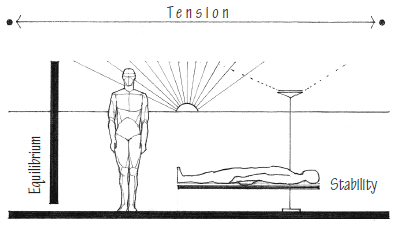
Diagonal lines can be seen as rising / falling. They imply movement. They are visually active & dynamic. Curved lines tend to express gentle movement. With their orientation, they can be uplifting / represent solidity & attachment to the earth. Small curves can express playfulness, energy, or patterns of biological growth.

Without lines, we would not be able to define shape; by which we generally recognise things. Lines describe edges of shape & separate it from the space around it. Contours of these lines imbue the shape with their expressive qualities.
Lines can articulate edges of planes & corners of volumes. These lines can be expressed either by absence of material (reveals & recessed joints) or by application of trim. Lines can also create texture & patterns on surfaces of forms.


Plane
A line shifted in a direction other than its intrinsic direction defines a plane. Planes have 2 dimensions; width & length but no depth.
Shape is the primary characteristic of a plane. True shape of a plane is shown only when we view it frontally. Planar forms have significant surface qualities of material, colour, texture, & pattern. These visual characteristics affect the qualities of a plane: (a) Visual weight & stability, (b) Perceived size, proportion & position in space, (c) Light reflectivity, (d) Tactile characteristics, (e) Acoustic properties

Planar forms are elements of architecture & interior design. Floor, wall & ceiling / roof planes enclose & define 3-D volumes of space. Their specific visual characteristics & relationships in space determine form & character of the space they define. Within these spaces, furnishings & other interior design elements can be seen to consist of planar forms.
Volume
Plane extended in a direction other than along its surface forms a volume. Volumes exist in 3-D. 'Form' describes contour & overall structure of a volume. Form is determined by shapes & interrelationships of lines & planes that describe its boundaries. Volume can be a solid (space displaced by mass of a building / building element) or a void (space contained & defined by wall, floor, ceiling or roof planes). When reading orthographic plans, it is important to perceive this duality of containment vs displacement.

Duality of solid forms & spatial voids represents essential unity of opposites that shapes architecture & interior design. Visible forms give spaces dimension, scale, colour & texture. Space reveals the forms.


3.3 Shapes
Primary means for distinguishing forms from another. May refer to contour of a line, outline of a plane, or boundary of a 3-D mass. Defined by specific configuration of lines / planes that separates a form from its background / surrounding space.
Natural shapes: images & forms of our natural world. May be abstracted, usually via a process of simplification & still retain essential characteristics of their natural sources.
Nonobjective shapes: make no obvious reference to a specific object / to a particular subject matter. Some may result from calligraphy & carry meaning as symbols. Others may be geometric & elicit responses from their purely visual qualities.

Geometric shapes dominate architecture & interior design. Types of geometric shapes: rectilinear & curvilinear. Most significant geometric shapes are: circle, triangle & square. Extended to 3-D, they generate sphere, cylinder, cone, pyramid & cube.

Circle
Compact, introverted shape with center point as its natural focus. Represents unity, continuity, & economy of form.
A circular shape is normally stable & self-centering in its environment. When associated with other lines & shapes a circle can appear to have motion.
Other curvilinear lines & shapes can be seen to be fragments / combos of circular shapes. Whether regular / irregular, curvilinear shapes are capable of expressing softness of form, fluidity of movement, or nature of biological growth.

Triangle
Represents stability. Triangular shapes & patterns are often used in structural systems, as their configuration cannot be altered without bending / breaking one of their sides.
A triangular shape is perceived as stable when resting on one of its sides. When tipped to stand on one of its points it becomes dynamic. It can exist in a precarious state of balance / imply motion, as it tends to fall over. Dynamic quality of a triangular shape is also due to the angular relationships of its 3 sides. As these angles can vary, triangles are more flexible than squares & rectangles. Triangles can be conveniently combined to form any number of square, rectangular & other polygonal shapes.


Square (& Rectangles)
Represents the pure & the rational. Equality of its 4 sides & right angles adds to its regularity & visual clarity. It has no preferred / dominant direction. It is a stable, tranquil figure when resting on one of its sides, but is dynamic when standing on 1 of its corners.
All other rectangles can be considered to be variations of the square. While clarity & stability of rectangular shapes can lead to visual monotony, variety is added by varying size, proportion, colour, texture, placement, or orientation.


3.4 Texture
Refers to the 3-D structure of a surface. Most often used to describe relative smoothness / roughness of a surface. 2 basic types of texture: (a) Tactile texture: real & can be felt by touch (b) Visual texture: seen by the eye. All tactile textures provide visual texture as well. Visual textures may be illusory / real.
As our eyes read visual texture of a surface, we often respond to its apparent tactile quality without actually touching it but based on textural qualities of surfaces on previous associations with similar materials. Touch is very closely related to emotional feelings.

Perception of Textures
Scale, viewing distance & light are important in perception of textures.
Relative scale of a texture can affect the apparent shape & position of a plane in space. The finer the scale of a textural pattern, the smoother it appears to be. Even coarse textures, when seen from afar, can appear to be relatively smooth. Textures with a directional grain can accentuate a plane's length / width. Coarse textures can make a plane appear closer, reduce its scale & increase its visual weight. Textures tend to fill the space they exist visually.

Direct light enhances visual texture. Diffused lighting deemphasises physical texture & can even obscure its 3-D structure. Smooth, shiny surfaces reflect light well, appear sharply in focus & attract our attention. Surfaces with a matte / medium-rough texture absorb & diffuse light unevenly, appearing less bright. Very rough surfaces, when illuminated with direct lighting, cast distinct shadow patterns of light & dark.

Contrast
Contrast affects the apparent strength / subtlety of adjacent textures. A texture seen against a uniformly smooth background appears more obvious than when placed in a similar texture. When seen against a coarser background, the texture appears to be finer & reduced in scale.

Maintenance
Texture is a factor in maintenance of materials & surfaces of a space. Smooth surfaces show dirt & wear but are relatively easy to clean. Rough surfaces may conceal dirt but may be more difficult to maintain.
Texture & Pattern
Texture & pattern are closely related design elements. Pattern is the decorative design / ornamentation of a surface that is based on repetition of a motif; a distinct & recurring shape, form, or colour in a design. Repetitive nature of a pattern often gives a textural quality. A pattern reduced in scale becomes texture.

Integral pattern results from nature of a material & how it is processed, fabricated, or assembled. Applied pattern is added to a surface after fabrication / being built.

Combining Textures
Scale of a textural pattern should be related to scale of a space & its major surfaces, & to size of secondary elements. As texture visually fills spaces, textures used in a small rooms should be subtle. In a large room, texture can be used to reduce the scale of the space / to define a more intimate area within it.
Rooms with little textural variation can be bland. Combos of hard & soft, even & uneven, shiny & dull textures can create variety & interest. Attention should be paid to ordering & sequence of textures. Harmony among contrasting textures can be sustained if they share a common trait, e.g. degree of light reflectance or visual weight.

3.5 Colour
Colour, like shape and texture, is an inherent visual property of all form. Within the visible spectrum of light, colour is determined by wavelength. When these coloured lights are present in a light source in approximately equal quantities, they combine to produce white light; light that is apparently colourless.
Research suggests that humans exposed to same colours tend to see colours in similar ways. Thus people in very different environments may perceive colours differently.


Ageing
With ageing, lens of eyes become more yellow. By age 70, most see through a lens roughly colour of ginger ale, especially when distinguishing between blues & purples. Using rich, saturated colours & plentiful lighting helps. Aging may increase incidence of cataracts, causing lens to turn cloudy with a yellowish, brownish tint; macular degeneration, which blurs central vision & makes objects less bright; & effects of glaucoma / dementia.
Avoiding contrast on surfaces like walls & floors helps clients avoid seeing them as holes that could cause a misstep / fall. Yellow colour schemes may be avoided due to effects of cataracts. Rather than avoiding specific colours, designing with the whole spectrum of the outdoors may be better. With ageing, sensitivity to glare appears hence a matte / lower sheen may be a better approach than a high gloss. Testing a potential colour with a variety of natural & artificial light sources is a good idea.
Light Sources
In northern climates, the red & orange end of full-spectrum daylight is partially blocked, while the blue end passes through, making some paint colours appear greenish.
When white light falls on an opaque object, selective absorption occurs. Surface of the object absorbs certain wavelengths of light & reflects others. Our eyes apprehend colour of the reflected light as colour of the object.
Some light sources; like some electric lamps / light reflected off a coloured walls, may not be well balanced & thus lack part of the spectrum. This lack of certain colours will make a surface illuminated appear to lack those colours.
Artificial lighting has its own colour bias. LED light tends to be whiter & more neutral than other sources, but can be programmed for different wavelengths & intensity. Fluorescent bulbs produce a cool blue light, while incandescent bulbs shift light colour toward a warm orange.
Coloured Light & Colour Pigments
Wavelengths / bands of light absorbed / reflected as object colour depends on pigmentation of a surface. Red surface appears red as it absorbs most of the blue & green light falling on it; a blue surface absorbs the reds. A black surface absorbs the entire spectrum; a white surface reflects all of it.
Surface has natural pigmentation of its material. This colouration can be altered with application of paints, stains, or dyes that contain colour pigments. While coloured light is additive in nature, colour pigments are subtractive. Each pigment absorbs certain proportions of white light. When pigments are mixed, their absorptions combine to subtract various colours of the spectrum. Colours that remain determine hue, value & intensity of mixed pigment.
(Coloured lights combine by additive mixing)

(Pigment colours combine by subtractive mixing)
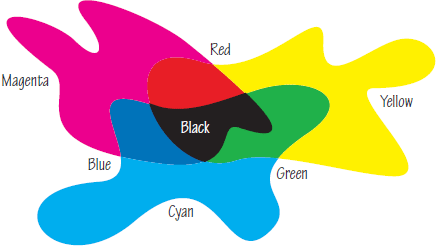
Colours on computer screens are coloured light, while colours in printed materials & samples are pigments. For accuracy, use physical colour samples viewed in the light that will be used.
3 Dimensions of Colour
Hue: attribute by which we recognise & describe a colour, like red / yellow.
Value: degree of lightness / darkness of a colour in relation to white & black.
Saturation: brilliance / dullness of a colour; depends on amount of hue in a colour.
All of these attributes of colour are interrelated. Each principal hue has a normal value. E.g. pure yellow is lighter in value than pure blue. If white, black, or a complementary hue is added to a colour to lighten / darken its value, its saturation will be diminished as well. It is difficult to adjust 1 attribute without simultaneously altering the other 2.
A number of colour systems attempt to organise colours & their attributes into a visible order. Simplest type like the Brewster/Prang colour wheel, organises colour pigments into primary, secondary & tertiary hues.
Primary hues: red, yellow & blue. Secondary hues: orange, green & violet. Tertiary hues: red-orange, yellow-orange, yellow-green, blue-green, blue-violet & red-violet.

Commission Internationale de l'Eclairage (CIE) standards are based on precise measurement of light waves reflected by a surface, factored by sensitivity curves for the human eye. Though cumbersome to use, CIE standards are specified by most U.S. furniture manufacturers.

Colour maps, like the colour space developed by Munsell allow colour communication between any 2 individuals with the same map.

Systems like Pantone® for architecture & interiors provide interior designers with a way to specify, communicate & manage colour choices for a wide variety of materials.

Other tools are electronic colour analysers that identify colour data from samples & colour viewing lights which simulate varied lighting conditions. Electronic colour analysis is commonly used for paint matching.
Altering Colour
Object colourants, like paints & dyes, modify colour of the illuminating light, changing what we interpret. In mixing pigments of paints & dyes, attributes of colour can be altered.
Hue can be changed by mixing it with other hues. When neighbouring / analogous hues are mixed, harmonious & closely related hues are created. Mixing complementary hues (hues directly opposite), produces neutral hues.

Value of a colour is raised by adding white & lowered by adding black. Lightening a hue's normal value creates a tint of that hue; darkening hue's normal value creates a shade of the hue. High-value colours like yellow, are capable of more shades than tints. Low-value colours like red are able to have more tints than shades. Intensity of a colour can be strengthened by adding more of the dominant hue. It can be lowered by mixing / adding grey. Hues that are greyed / neutralised like this are 'tones'.

Effects of light & juxtaposition of surrounding / background colours can change an object's colour. Light of a particular hue other than white is rarely used for general illumination. But, not all sources of white light are spectrally well balanced. Incandescent bulbs cast a warm glow, while some fluorescents cast a cool light. Colour of a large reflecting surface can alter light within an interior space. Coloured light changes colour of object it is reflected from. E.g. an appealing red apple can become a very unappealing grey one. Thus avoid negative effects when using coloured light. Observing colour firsthand, considering the sun's angle & direction along with amount & quality of artificial light, verifies what a colour will actually look like.
Daylight can be warm / cool, depending on time of day & direction it comes from. Colour of sunlight throughout the day changes colour perception. Human eyes see better during day than night & our brains adjust to figure out what colour we are really observing (our chromatic bias). Morning & evening have an orange bias. Midday light under a clear sky has a blue bias. Our brains auto-shift by subtracting prevailing bias as quality & angle of light changes. Rapid changes in light during transition periods from dawn to early morning and twilight & dusk to dark can throw off this adjustment. These times of day are the worst times to make colour decisions. Warm light tends to accentuate warm colours & neutralise cool hues, while cool light intensifies cool colours & weakens warm hues. If light is altered with a particular hue, it raises intensity of colours of that hue & neutralises colours of a complementary hue.
Apparent value of a colour can be altered by amount of light used to illuminate it. Lowering amount of illumination darkens a colour's value & neutralises its hue. Raising lighting level will lighten colour's value & enhance its intensity. But high levels of illumination can make colours appear less saturated / washed out.

Natural fluctuations of light in an interior setting can alter colours in subtle ways. Colours may look different depending on angle to the viewer.
Mixing 2 complementary colour pigments results in a neutralised / greyed hue, but placing them next to each other can produce the opposite. In 'simultaneous contrast', eye tends to generate a colour's complementary hue & project it as an afterimage on adjacent colours. 2 complementary colours next to each other tends to heighten each other's saturation & brilliance without an apparent change in hue.
When 2 colours are not complementary, each will alter the other with its own complement & shift it toward that hue. The 2 colours are pushed farther apart in hue.
Simultaneous contrast in hue is most easily perceived both colours are fairly uniform in value. If 1 is much lighter / darker, the effects become more noticeable.
Simultaneous contrast also affects apparent value of a colour, which can be made to appear lighter / darker according to the value of its background colour. Light colours tend to deepen dark colours, while dark colours tend to brighten a light colours.

Outlining colours with black & white has effects. With black: richer & more vibrant. With white: the opposite effect. Large area of white reflects light onto adjacent colours, while thin white lines spread & alter the hues they separate.

Optical mixing occurs when dots / strokes of colours merge to produce more blended hues. Eyes have no time to adjust to their differences & they mix colours optically. It is often used in weaving of textiles to create an impression of many hues & values with a limited number of coloured yarns / threads.

How Colour Affects Perception of Form
Reds, oranges & yellows are warm colours that advance. Blues, greens & violets are cooler & tend to recede. Neutrals like greys & off-whites are either warm (brownish) / cool (bluish).
Warmth / coolness of a colour's hue, relative value & degree of saturation determines the visual force used to attract our attention, bringing focus to an object & creating a sense of space.

Warm hues & high intensities are visually active & stimulating. Cool hues & low intensities are subdued & relaxing. Light values tend to be cheerful, middle values undemanding & dark values somber.
Bright, saturated colours & any strong contrasts attract our attention. Greyed hues & middle values are less forceful. Contrasting values make us aware of shapes & forms. Contrasting hues & saturations can define shape.
(Value contrast aids in our perception of shape)

Deep, cool colours appear to contract. Light, warm colours tend to expand & increase apparent size of an object, especially when against a dark background.
When used on an enclosing plane of a space, light values, cool hues & greyed colours appear to recede & increase apparent distance. Thus they can enhance spaciousness of a room & increase its apparent width, length, or ceiling height.
Warm hues appear to advance. Dark values & saturated colours suggest nearness. They can diminish scale of a space / in an illusory way, shorten a room's dimensions.
These colour generalisations have complex interrelationships. E.g. though blue is considered cool & red warm, a vibrant electric blue may not strike us as cooler than a soft rose. Our emotional reactions to colour vary with personal experiences. Favoured colour combos are subject to fashion trends, with certain colour palettes closely tied to specific times / places.
Research into effects of colour in workspaces has shown that white, though crisp & clean, does not aid productivity. Red aids detail-oriented workers & can raise: blood pressure, respiration, heartbeat & alertness. Blue aids creativity & green inspires innovation. Women have an extra gene that makes it possible to detect more variations in the red-orange spectrum than men. Experts recommend avoiding yellow in conference rooms & the suppressive impact of grey.
Though vibrant colours & patterns can create a lively environment, too much can produce visual chaos.

(effect of values on spatial boundaries)

(Monochrome: vary value of a single hue)


(Analogous: use 2 or more hues from the same quarter of the colour wheel)

(Complementary: use 2 hues on opposite sides of the colour wheel)

(Split complementary: combine 1 hue with 2 hues adjacent to its complement)

(Triadic: use colours located at 3 equidistant points on colour wheel)

(Contrasting hue schemes are based on complementary / triadic colour combinations)

Colour Schemes
There are not good/bad colours. Some are simply in / out of fashion at a given time; appropriate / inappropriate given a specific colour scheme. Suitability depends on how & where it is used and how it fits the palette of a colour scheme.
Manufacturers design colour series for paints that suggest compatible colour selections. They may be built on gradations of pigments; based on references to nature, fabrics, or other materials; or developed for emotional, historic, or similar associations.
If colours are notes of a musical scale, colour schemes are musical chords. They structure colour groups according to visual relationships among their attributes of hue, value & intensity.
2 broad types of hue schemes:
Related: based on a single hue / series of analogous hues, promote harmony & unity. Varying value & intensity, including small amounts of other hues as accents, bringing shape, form & texture into play allows for variation.
Contrasting: based on complementary / triadic colour combos, are more rich & varied as they always include warm & cool hues.
Colour triangle by Faber Birren shows how modified colours (tints, tones & shades) may be related in a harmonious sequence. It is based on 3 basic elements: pure colour, white & black. They combine to create secondary forms of tint, shade, grey & tone. Bold-line paths shown define a harmonious sequence, since each involves a series of visually related elements.

Whether a colour scheme is lively & exuberant or restful & quiet depends on chromatic & tonal values of hues chosen. Large intervals between colours & values creates lively contrasts & dramatic effects. Small intervals have more subtle contrasts & patterns.

For interior colour schemes, consider chromatic & tonal key to be established & distribution of the colours. Scheme must satisfy purpose & use of the space & also consider its architectural character.
Decisions are made regarding major planes of an interior space & how colour might be used to modify their apparent size, shape, scale & distance. Which elements form the background, middle ground & foreground? Any architectural / structural features that should be accentuated / undesirable elements to be minimised?
Usually, largest surfaces of a room (floor, walls & ceiling) have the most neutral values. Secondary elements like large pieces of furniture / area rugs can have greater chromatic intensity. Accent pieces, accessories & other small-scale elements can have the strongest chroma for balance & to create interest.
Neutral colour schemes are the most flexible. For dramatic effect, main areas of a room can be given more intense values, while secondary elements have lesser intensity. Large areas of intense colour should be used with caution, particularly in a small room. They reduce apparent distance & can be visually demanding.

Tonal distribution; pattern of lights & darks in a space. Usually best to use varying amounts of light & dark values with a range of middle values to serve as transitional tones. Avoid using equal amounts of light & dark unless a fragmented effect is desired.

3.6 Organising Elements
It involves pattern making. In a design pattern, all elements depend on one another for visual impact, function & meaning.
Visual relationships established among elements are ordered by proportion, scale, balance, harmony, unity and variety, rhythm & emphasis. (guidelines to possible ways design elements can be arranged into recognisable patterns)
Proportion
Relationship of 1 part to another / to the whole, or between 1 object & another. This may be one of magnitude, quantity, or degree.
Matter of proportion is one of critical visual judgment. A proportion will appear correct for a given situation when we sense that neither too little nor too much of an element / characteristic is present.
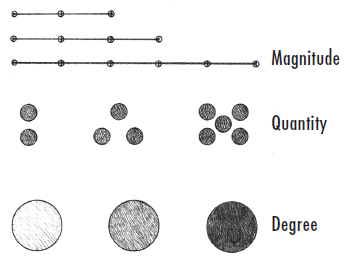

We are concerned with proportional relationships between parts of an element, between elements & between the elements & spatial enclosure.


Scale
Proportion & scale deal with relative sizes of things. If there is a difference, proportion is relationships between parts of a composition, while scale is the size of something relative to a standard / recognised constant.
Mechanical scale: calculation of physical size with standard system of measurement. E.g. a table is, according to U.S. Customary System, 3 feet wide, 6 feet long, and 29 inches high. Using International System of Units (metric system), the table is 914 mm wide, 1829 mm long, and 737 mm high.

Visual scale: size relative to other objects in environment / surrounding space. E.g. the table can appear to be in scale / out of scale with a room, depending on relative size & proportions of the space.
Something is small scale if we measure it against other things that are generally much larger, vice versa.
Human scale: feeling of smallness / bigness a space / interior element gives us. If dimensions of an interior space / sizes of elements make us feel small, they lack human scale. If they do not dwarf us / comfortable fit they are human in scale.
Doorways, windowsills, tables & chairs are used to discern human scale as we are used to their dimensions.

Interior details near eye level can bring scale of an architectural space down to human size. E.g. a chair rail along a wall creates a visual line at roughly hand height.
Interior elements can be related to the whole space, to each other & to users of the space. Unusually scaled elements can attract attention / create & emphasise a focal point.
Visual Weight
Interior spaces often include a mix of shapes, sizes, colours & textures. Organization of these elements meet functional needs & aesthetic desires. They should also be arranged to achieve visual balance; a state of equilibrium among visual forces projected.
Each element has specific shape, form, size, colour, texture, location & orientation to determine the visual weight of each element & how attention each will attract.
Characteristics that increase visual weight of an element (attract our attention) include:
(i) Irregular / contrasting shapes, (ii) Bright colours & contrasting textures, (iii) Large dimensions & unusual proportions, (iv) Elaborate details
(mix of shapes, colours & textures)


Visual Balance
Our perception of elements varies as our POV moves. Spaces undergo changes as illumination changes by day, occupied by people and paraphernalia, and modified over time. Visual balance among elements thus are considered in 3 dimensions & must withstand the changes brought about by time & use.
3 types of visual balance: symmetrical, radial & asymmetrical.
1. Symmetrical balance
Results from arrangement of identical elements, in shape, size & relative position, about a common line / axis. (aka axial or bilateral symmetry)
Usually results in a quiet, restful & stable equilibrium that is readily apparent, especially when oriented on a vertical plane. Depending on its spatial relationships, a symmetrical arrangement either emphasises its central area / terminations of its axis.
(focus on central area)

(Focus on termination of an axis)

Simple but powerful device to establish visual order. But total symmetry is often undesirable / difficult to achieve due to function / circumstance.
Arranging 1 or more parts of a space in a symmetrical manner for local symmetry is often desirable / possible. Symmetrical groupings within a space are easily recognised & have a quality of wholeness that can serve to simplify / organise the room's composition.

2. Radial balance
Results from arrangement of elements about a center point. Produces a centralised composition that focuses on the middle ground. Elements can focus inward to the center, face out from the center, or be placed about a central element.
3. Asymmetrical balance
Recognised as the lack of correspondence in size, shape, colour, or relative positioning. Asymmetrical composition incorporates dissimilar elements.
For occult / optical balance, it must consider visual weight of each element & employ the principle of leverage in the arrangement. Visually forceful elements; unusual shapes, bright colours, dark values, variegated textures, are counterbalanced by less forceful elements that are larger / placed farther away from center of the composition.

Not as obvious as symmetry. It is often more visually active & dynamic. Capable of expressing movement, change, even exuberance. More flexible than symmetry & can adapt more readily to varying conditions of function, space & circumstance.


Harmony
Defined as consonance / pleasing agreement of parts in a composition. Balance achieves unity via careful arrangement of similar & dissimilar elements. Harmony involves careful selection of elements that share a common characteristic like shape, colour, texture, or material. Repetition of a common trait produces unity & visual harmony. Harmony when carried too far can result in a unified but uninteresting composition.

Variety
At the extreme can result in visual chaos. It is the careful & artistic tension between order & disorder; between unity & variety, that enlivens harmony and creates interest in an interior setting.
Means for achieving balance & harmony are intended to include in their patterns the presence of dissimilar elements and characteristics.
E.g. asymmetrical balance produces equilibrium among elements that differ in size, shape, colour, or texture. Harmony produced by elements that share a common traits permits same elements to also have a variety of unique, individual traits.

Grouping
Dissimilar elements can be organised by grouping them in close proximity / relating them to a common line or plane. We tend to read such a grouping as an entity, to the exclusion of other elements farther away.

Rhythm
Based on repetition of elements in space & time. Creates visual unity & induces a recurring continuity of movement that a viewer's eyes & mind can follow along a path, within a composition / around a space.
Simplest form of repetition consists of regular spacing of identical elements along a linear path. It can be monotonous but it can be useful in establishing a background rhythm for foreground elements / defining a textured line, border, or trim.

More intricate patterns of rhythm can be produced by considering tendency for elements to be visually related by proximity to one another / sharing of a common trait.
Spacing of recurring elements & pace of the visual rhythm can be varied to create sets & to emphasise certain points in the pattern. Resulting rhythm may be graceful & flowing / crisp & sharp. Contour of rhythmic pattern & shape of individual elements can reinforce nature of the sequence.
Recurring elements must share a common trait for continuity but can vary in shape, detail, colour, or texture. These differences create visual interest & can introduce other levels of complexity. An alternating rhythm can be superimposed over a more regular one / variations can be progressively graded in size or colour value to give a direction to the sequence.

Visual rhythm is most easily recognised when repetition forms a linear pattern. Within an interior space, nonlinear sequences of shape, colour & texture can provide subtler rhythms.

Rhythm may refer to movement of our bodies as we advance through a sequence of spaces. Rhythm incorporates fundamental notion of repetition as a device to organise forms & spaces in architecture. Beams & columns repeat themselves to form repetitive structural bays & modules of space. Spaces often recur to accommodate similar / repetitive functional requirements in the building program.
(Rhythm connecting points in space)

Emphasis
Principle of emphasis assumes coexistence of dominant & subordinate elements in composition of an interior setting. Design without any dominant elements would be bland. With too many assertive elements, design will be cluttered & chaotic. Each part of a design should be given proper significance according to its degree of importance in the overall scheme.
Discernible contrast is established between dominant (important) element or feature & subordinate aspects of the space by giving visual emphasis via significant size, unique shape, or contrasting colour, value, or texture to attract our attention by interrupting the normal pattern of the composition.


An element / feature can also be visually emphasised by strategic position & orientation in a space. It can be centerpiece of a symmetrical organization. In an asymmetric composition, it can be offset / isolated from the other elements. It can be the termination of a linear sequence / a path of movement.

To enhance its visual importance, an element can be oriented to contrast with the normal geometry of the space & other elements within it. It can be illuminated in a special manner. Lines of secondary & subordinate elements can be arranged to focus our attention on the significant element / feature.
Strategies for creating emphasis using lighting & colour together include: (i) String rope lighting in / around a ceiling to add dimension & lighten darker hues. (ii) Suspend eye-catching pieces in a tall, colourful lobby to emphasise its height. (iii) Smaller, separate light fixtures to create individual spaces.
There can be varying degrees of emphasis. Once significant elements are established, a strategy for orchestrating subordinate elements enhances the dominant ones.
A room's focal points should be created with some subtlety & restraint as they must remain integral parts of the overall design. Secondary points of emphasis; visual accents, can often help knit together dominant & subordinate elements. Following the principle of harmony, related shapes, colours & values can also help retain unity of design.


Summary
Summary
1. Designers must see & be conscious of specific visual characteristics of things & how they relate & interact to form aesthetic quality of our visual environments.
2. Form is shape & structure from its material.
3. Primary elements of form: point, line, plane & volume.
4. As a point moves, it leaves a trace of a line. As the line shifts in direction, it defines a plane. As the plane extends perpendicular to its surface it forms a volume.
5. A point marks a location in space.
6. Lines may vary in weight, contour & texture. A straight line represents tension between 2 points. A horizontal line represents stability. A vertical line represents a state of equilibrium with gravity. Curved lines express gentle movement.
7. Lines define shapes, articulate edges & create textures and patterns.
8. Planes vary by material, colour, texture & pattern to create differences in visual weight and stability, perceived size, proportion and position in space, light reflectivity, tactile traits & acoustic traits.
9. Floor, wall & ceiling / roof planes enclose & define 3-D volumes of space.
10. ‘Form' describes contour & overall structure of a volume.
11. Volumes can be solid or void. Duality of solid forms & spatial voids represents essential unity of opposites that shapes architecture & interior design.
12. Distinguish forms via shapes. Natural shapes are images & forms of our natural world. Nonobjective shapes make no obvious reference to a specific object / subject matter. Geometric shapes dominate architecture & interior design.
13. Most significant geometric shapes are circle, triangle & square and when extended to 3-D creates spheres, cylinders, cones, pyramids & cubes.
14. Texture refers to 3-D structure of a surface. 2 basic types of texture: Tactile texture (felt) & Visual texture (seen).
15. Perception of textures is affected by scale, viewing distance & light.
16. Finer scale of a textural pattern will appear smoother than it is. Coarse textures when seen afar can appear smooth. Smooth, shiny surfaces reflect light well. Matte / medium-rough textures absorb & diffuse light unevenly, appearing less bright. Rough surfaces, with direct lighting, cast distinct shadow patterns of light & dark.
17. Repetitive nature of a pattern often gives a textural quality. A pattern reduced in scale becomes texture.
18. As texture visually fills spaces, textures used in a small rooms should be subtle.
19. Combos of hard & soft, even & uneven, shiny & dull textures can create variety & interest.
20. Object colour depends on pigmentation of a surface. E.g. Red surface appears red as it absorbs most of blue & green light falling on it. A black surface absorbs the entire spectrum; a white surface reflects all of it.
21. Colouration of a material can be altered with paints, stains or dyes that contain colour pigments.
22. Coloured light is additive in nature while colour pigments are subtractive.
23. When pigments are mixed, their absorptions combine to subtract various colours of the spectrum. Colours that remain determine the hue, value & intensity of mixed pigment.
24. 3 dimensions of colour are: Hue, Value & Saturation.
25. Hue: how we recognise & describe a colour. E.g. red, yellow
26. Value: degree of light/dark of a colour
27. Saturation: brilliance/dullness of a colour
28. It is difficult to alter 1 of the 3 without altering the others.
29. Colour systems organise colours: Brewster/Prang colour wheel, CIE Chromaticity Diagram, Munsell Colour Space.
30. Analogous colours are neighbouring colours on the colour wheel while complementary colours are directly opposite on the colour wheel.
31. Lightening a hue’s normal value creates a tint. Darkening a hue creates a shade. Hues that are mixed / have added grey creates tones.
32. Amount & quality of artificial and natural light can affect how a colour will actually look.
33. Morning & evening have an orange bias. Midday light under a clear sky has a blue bias.
34. Simultaneous contrast refers to how 2 different colours, when adjacent, affect each other.***
35. Outlining colours with black makes them more rich & vibrant (vice versa for white)
36. Optical mixing occurs when dots / strokes of colours merge to produce more blended hues.
37. Warmth / coolness of a colour's hue, relative value & degree of saturation determines the visual force used to attract our attention, bringing focus to an object & creating a sense of space.
38. Warm hues & high intensities are visually active & stimulating. Cool hues & low intensities are subdued & relaxing.
39. Contrasting values make us aware of shapes & forms.
40. Deep, cool colours appear to contract. When on an enclosing plane of space, they appear to recede & increase apparent distance. They enhance the spaciousness of a room.
41. Dark values & saturated colours suggest nearness. They can diminish the scale of a space / in an illusory way, shorten a room's dimensions.
42. Though vibrant colours & patterns can create a lively environment, too much can produce visual chaos.
43. Monochrome: vary value of a single hue
44. Analogous: use 2 or more hues from the same quarter of the colour wheel
45. Split complementary: combine 1 hue with 2 hues adjacent to its complement
46. Triadic: use colours located at 3 equidistant points on colour wheel
47. Suitability of colours depends on how it is used, where it is used & how it fits the palette of a colour scheme.
48. 2 broad hue schemes: Related (based on a single hue / series of analogous hues) & Contrasting (based on complementary / triadic colour combos)
49. Colour triangle by Faber Birren shows how modified colours (tints, tones & shades) may be related in a harmonious sequence.
50. Colour schemes with large intervals between colours & values creates lively contrasts & dramatic effects. Small intervals have more subtle contrasts & patterns.
51. Colour schemes satisfy purpose & use of a space whilst considering chromatic, tonal key & architectural character.
52. Usually, the largest surfaces of a room (floor, walls & ceiling) have neutral values. Secondary elements like large pieces of furniture / area rugs can have greater chromatic intensity. Accent pieces, accessories & other small-scale elements can have the strongest chroma for balance & to create interest.
53. For dramatic effect, main areas of a room can be given more intense values but they reduce apparent distance & can be visually demanding.
54. Tonal distribution is the pattern of light & darks in a space.
55. Organising elements includes: Proportion, Scale, Visual Weight, Visual Balance, Harmony Variety, Grouping, Rhythm & Emphasis.
56. Proportion is the relationship of 1 part to another, to the whole or between objects in terms of magnitude, quantity or degree.
57. Consider proportional relationships between parts of an element, between elements & between the elements & spatial enclosure.
58. Scale is the size of something relative to a standard. Mechanical scale is calculation of size with a system of measurement e.g. metric system. Visual scale is size relative to other objects in the surrounding space. Human scale is the feeling of smallness / bigness a space / interior element gives us.
59. Doorways, windowsills, tables & chairs are used to discern human scale as we are used to their dimensions. Unusually scaled elements can attract attention / create & emphasise a focal point.
60. Visual weight of an element refers to its ability to attract our attention. This is done via Contrasting shapes, bright colours, contrasting textures, large dimensions, unusual proportions, elaborate details.
61. Visual balance among elements are considered in 3 dimensions & must withstand the changes brought about by time & use.
62. 3 types of visual balances are symmetrical, radial & asymmetrical.
63. Symmetrical balance comes from arrangement of identical elements about a common axis. It can focus on the central area or termination of an axis. It is a simple but powerful device to establish visual order.
64. Radial balance comes from arrangement of elements about a center point. It produces a centralised composition that focuses on the middle ground.
65. Asymmetrical composition incorporates dissimilar elements. Visually forceful elements; unusual shapes, bright colours, dark values, variegated textures, are counterbalanced by less forceful elements. It is more flexible than symmetry & can adapt more readily to varying conditions of function, space & circumstance.
66. Harmony is the consonance / pleasing agreement of parts in a composition. Involves careful selection of elements that share a common characteristic. The repetition of a common trait produces unity & visual harmony.
67. It is the careful & artistic tension between order & disorder; between unity & variety, that enlivens harmony & creates interest in an interior setting.
68. Dissimilar elements can be organised by grouping them in close proximity / relating them to a common line or plane.
69. Rhythm is based on repetition of elements in space & time. It creates visual unity & induces a recurring continuity of movement that a viewer's eyes & mind can follow along a path. Recurring elements must share a common trait for continuity but can vary in shape, detail, colour, or texture to create visual interest & can introduce other levels of complexity.
70. Principle of emphasis assumes coexistence of dominant & subordinate elements in composition of an interior setting.

Comments